

Spotted an error? Did you work on this production, or do you keep a memory or a document from it? We would be glad to hear from you.
“Our styles were already alike.”
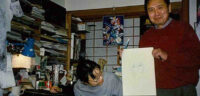
Next to Shingo Araki's name in the credits of Ulysses 31, there is another — often overlooked by Western audiences: Michi Himeno. Co-character designer of the series, Araki's assistant turned full partner, she drew Thémis (Yumi in the English version), Noumaïos (Numinor), Penelope, Nestor and Eurycleia — and left her mark on fifteen of the twenty-six episodes. In this interview, she looks back on discovering Araki's drawings as a teenager, on the very real difficulty of a first collaboration with a foreign studio, and on the “secret” of a single style behind two signatures. SAKUGAART presents an editorial account of the interview, together with the episode-by-episode breakdown she shared for the source book — a rare documentary record.
Himeno Michi
Japan
discovering Araki
Araki's assistant
Penelope · Nestor · Eurycleia
founded by Shingo Araki
Heathcliff · Rainbow Brite
The Rose of Versailles · Cobra
What follows is an editorial account of an interview given by Michi Himeno, assistant character designer to Shingo Araki on Ulysses 31. The questions have been rephrased and the answers are reported in SAKUGAART's own words, faithful to the content but without verbatim reproduction of the source. The order of the interview has been preserved. The table that closes the article is an exclusive documentary record shared by Michi Himeno for the source book, presented here with explicit attribution.
As a student, I had been amazed to discover Shingo Araki's drawings in the Japanese TV series Babel II. My wholehearted passion for that unique style inspired me and pushed me to take my first steps in animation.
A few years later, after the production of The Rose of Versailles, the Tokyo Movie Shinsha studio — today's TMS Entertainment — asked us to handle the character design of a Franco-Japanese series whose production had long been on hold. It was Ulysses 31. That was in 1980. I was then assistant to the chief character designer and animation director, who was none other than Shingo Araki himself.
I won't hide it: yes, it was very difficult. In the beginning, everything had to be built from scratch. Fortunately, we were very well organized.
The French sent us drawings annotated with specific remarks, so that we could adapt the main characters in our Japanese style.
Yes, very well. Araki-san was in charge of drawing Ulysses and Telemachus. As for me, I drew the secondary characters such as Thémis, Noumaïos, Penelope, Nestor and Eurycleia.
Nono's design, for its part, was taken over from the pilot version created by Yasuo Ōtsuka.
What if I told you there isn't one? [Laughs.] Ever since my student days, I have been a huge fan of Araki's drawings. From the very start of our collaboration, our styles were already alike. Over time, we influenced each other.
We loved from the outset the very particular look the characters gained from blending French and Japanese drawing. It was a successful combination. The challenge was considerable: we had to incorporate the French ideas while simplifying the drawings for the animators. We had to reconcile our Japanese touch with the French origins without distorting anything.
It was not easy, but the result is still very pleasing to watch today. This collaboration allowed us to showcase the quality of our studio while respecting DIC's original project.
Sadly no, because he was always between flights. The only real contact was when he sent two or three copies of drawings, which gave me an idea of what he wanted.
Very good ones. And it was not the last time: we had the opportunity to work together again on Lupin VIII, Inspector Gadget, Heathcliff and the Catillac Cats and Rainbow Brite. I loved the way they used color and the strength of their designs.
I still hope to have the joy of working together again someday. At my age, I'm afraid it would be difficult to serve as animation director… [Laughs.] Still, I might be able to take part in character design. Consider this an open invitation…
Exclusive Araki / Himeno breakdown — Ulysses 31, episode by episode
The document that follows is a rare documentary record : the precise, episode-by-episode division of Araki Production's work on Ulysses 31 (1980–1981) — additional character designs, animation direction (作監), key animation (原画 / genga), in-betweens (動画 / dōga). These data were shared by Michi Himeno herself for the source book; they exist in no public database. SAKUGAART presents them with explicit attribution and without substantive change.
| Episode | Additional characters | Animation direction (作監 sakkan) |
Key animation (原画 genga) |
In-betweens (動画 dōga) |
|---|---|---|---|---|
| 1The Cyclops, or the Curse of the Gods | Himeno | Araki | Araki / Himeno | Araki Production + outside studios |
| 5The Lost Planet | Witch, unicorn: Himeno Dragon: Araki Frozen figures: Araki / Himeno |
Araki (Himeno: assisting) | part 1: Araki part 2: Himeno |
|
| 6Aeolus, or the Casket of Cosmic Winds | Aeolus: Himeno others: Araki |
part 1: Araki / Himeno part 2: Studio Emu |
||
| 2Hératos | Hératos: Araki Atina: Himeno |
Araki | Araki Production + outside studios |
|
| 9The Sphinx | Sphinx & Hermione: Araki / Himeno Thémis & Telemachus (mirror): Himeno |
|||
| 3The Wild Flowers | Himeno | Araki | — | Araki Production + outside studios |
| 8The Companions' Revolt | — | — | ||
| 16Circe the Sorceress | Circe & Hermes: Araki | Araki (Himeno: assisting) | ||
| 13The Sirens | Himeno | Araki | Araki / Himeno | |
| 20The Black Magician | Himeno | Araki (Himeno: assisting) | ||
| 19Atlas | Atlas, Nérus: Himeno / Araki | Araki (Himeno: assisting) | Araki / Himeno | |
| 21The Rebels of Lemnos | Women of Lemnos, naïms, shark men: Himeno / Araki | Araki | — | |
| 22The City of Cortex | Himeno | Araki | ||
| 26The Kingdom of Hades | Himeno | Araki | ||
| 18The Labyrinth of the Minotaur | Minos, Theseus: Araki Ariadne, Minotaur: Himeno |
— | ||
| OP / EDOpening and ending credits | — | Araki | Araki / Himeno | Araki Production |
Data shared by Michi Himeno for Les séries de notre enfance (M. Eluasti & N. Zemrak, Pollux, 2013). Presented with full attribution.
What the table reveals, as read by SAKUGAART
Three documentary lessons emerge from this exceptionally rare data set:
1. A genuine graphic co-production, not merely an assistant's role. Across the sixteen documented entries, Himeno's name appears at least once in every episode — as designer of secondary characters, in key animation, or assisting with animation direction. The credit “Araki's assistant” clearly understates the reality of her contribution.
2. Araki keeps control of animation direction (作監), the higher-ranking position — Himeno is regularly credited as “assisting.” The division mirrors the structure of Araki Production, where Himeno then held the rank of assistant before becoming, in the 1980s, a leading partner (notably on Saint Seiya).
3. Production of the in-betweens (dōga) was very largely outsourced : “Araki Production + outside studios” appears almost everywhere. A detail worth knowing for anyone interested in the material side of the series: the dōga, and therefore the cels derived from them, were traced and painted in several workshops, which may explain some stylistic variations from one episode to the next — and sometimes complicates the precise attribution of an individual piece.
Why this interview matters
French-language histories of Ulysses 31 credit Shingo Araki with the character design and stop there. Yet across the sixteen episodes documented by this table, half of the secondary characters were drawn by Michi Himeno — not to mention the key animation, where her name appears alongside Araki's. Giving her a voice, and publishing this episode-by-episode breakdown, restores to a co-author the place that the credits of the time gave her only on the second line.
Her testimony also confirms what other Japanese voices from the series — Kazuo Terada in particular — have described: the Franco-Japanese collaboration on Ulysses 31 was not subcontracting but a constant graphic negotiation, drawing by drawing, through the exchange of annotated copies. The series' “single style” is not one man's work: it is the documented result of a dialogue between two hands.
Related articles on SAKUGAART
- The entry on Ulysses 31 and the profile of Shingo Araki — her design partner.
- The interview with Kazuo Terada, Japanese co-director of Ulysses 31 — the same series seen from the director's chair.
- The profiles of Jean Chalopin and Bernard Deyriès — the French side.
- The feature on the Japanese animation production pipeline — to place sakkan, genga and dōga within the full workflow.
- Upcoming: an entry on Araki Production · a profile of Yasuo Ōtsuka (creator of Nono's original design).
Sources & references
- BnF — Ulysse 31 record (credits)Credits · institutional
- ANN Encyclopedia — Michi HimenoFilmography · credits
- Wikipédia FR — Michi HimenoBiography · partnership with Araki
Editorial transparency note. This interview and the episode-by-episode breakdown that accompanies it come from a reference documentary book devoted to the DIC studio — Les séries de notre enfance (M. Eluasti & N. Zemrak, Pollux, 2013). The interview appears on the double page 108–109; the breakdown (titled “Ulysses 31, 1980–1981 — database of the episodes in which Araki Production took part”) is presented there as an exclusive shared by Michi Himeno for the book. The questions have been rephrased and the answers reported in SAKUGAART's own words, faithful to the content of the interview but without word-for-word reproduction of the source. The table is presented with full and explicit attribution to Michi Himeno and to the book. Her date of birth (August 16, 1956) and her role on Ulysses 31 (assistant to Shingo Araki, character designer of the secondary characters) are independently corroborated by third-party sources (ANN, Wikipédia FR). This article is an original editorial synthesis, not a reproduction of its documentary source. Written for SAKUGAART, an editorial site devoted to Japanese animation.