

Spotted an error? Did you work on this production, or do you keep a memory or a document from it? We would be glad to hear from you.
The Ghibli Museum in Mitaka, a work by Miyazaki
Strictly speaking, there is no Ghibli Museum in Tokyo. The institution the whole world calls by that name stands in Mitaka, a suburb on the western edge of the metropolis, in Inokashira Park — and its official name is, precisely, the "Ghibli Museum, Mitaka" (Mitaka no Mori Ghibli Bijutsukan, the Ghibli Museum of the Mitaka Forest). Opened on October 1, 2001, it is no ordinary museum: designed by Hayao Miyazaki himself through storyboards, like a film, it is less a showcase for animation than the work of an architect-filmmaker, true to a programmatic motto — Let's get lost together. No set route, no photography allowed, and an admission ticket that is a real strip of 35mm film. SAKUGAART offers a reference feature on it, distinct from a tourist guide and focused on heritage.
Mitaka no Mori Ghibli Bijutsukan
Animation Museum
planned from 1998
through storyboards
with Miyazaki
Mitaka, western Tokyo
Mitaka 181-0013
4 entry time slots
Origins — a museum drawn like a film
The project was born in 1998, at a time when Studio Ghibli had already conquered the world but was looking for a permanent place to anchor its teaching and its heritage. The city of Mitaka, where Ghibli is based, offered it a plot of land in Inokashira Park. Construction began in March 2000; the museum opened on October 1, 2001. Miyazaki's son Goro, then a landscape designer and later a Ghibli director, took part in developing the project.
Here lies its founding singularity: Hayao Miyazaki designed the building himself, through storyboards, exactly as he prepares his films. Architect Keisuke Tanaka translated his drawn boards into technical plans. The museum is therefore not a commission handed to an architecture firm to house a collection: it is a Miyazaki drawing turned into a building. The distinction is crucial — it explains everything else.
The acknowledged architectural inspiration comes from Europe's hilltop villages, notably Calcata, a medieval Italian village Miyazaki is fond of. You find its spiral staircases, footbridges, bay windows and stained glass, the clumsy, joyful verticality of a building that seems to have been built piece by piece, with no overall plan — when in fact it has a meticulous one.
The philosophy: "Let's get lost together"
The museum's motto, written by Miyazaki, is a single short phrase: 「迷子になろうよ、いっしょに」 — Maigo ni narō yo, issho ni — "Let's get lost together." It is not a marketing slogan: it is an architectural and curatorial program applied to the letter.
There is no set route through the museum. No arrows on the floor, no room numbers, no suggested chronology. Visitors walk in and choose. They go up or down, take one door or another, walk along a balcony, cross an indoor bridge. This disorientation is deliberate — it reproduces in space the experience of childhood that all of Miyazaki's work explores: a world bigger than oneself, to be explored without a guide, where every corner holds a surprise.
The other principle is just as uncompromising: photography is strictly forbidden inside, and the staff enforce the rule without exception. The reason, which Miyazaki fully owns, is to make visitors look — to see with their own eyes, rather than through a screen they will check later. In an age when experience is largely mediated by the smartphone, this is a philosophical stance: the museum is not a backdrop to be exported, but a place to inhabit for two hours.
"The museum I want to make is one you leave richer than when you came in."
The architecture — an auteur's building
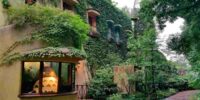
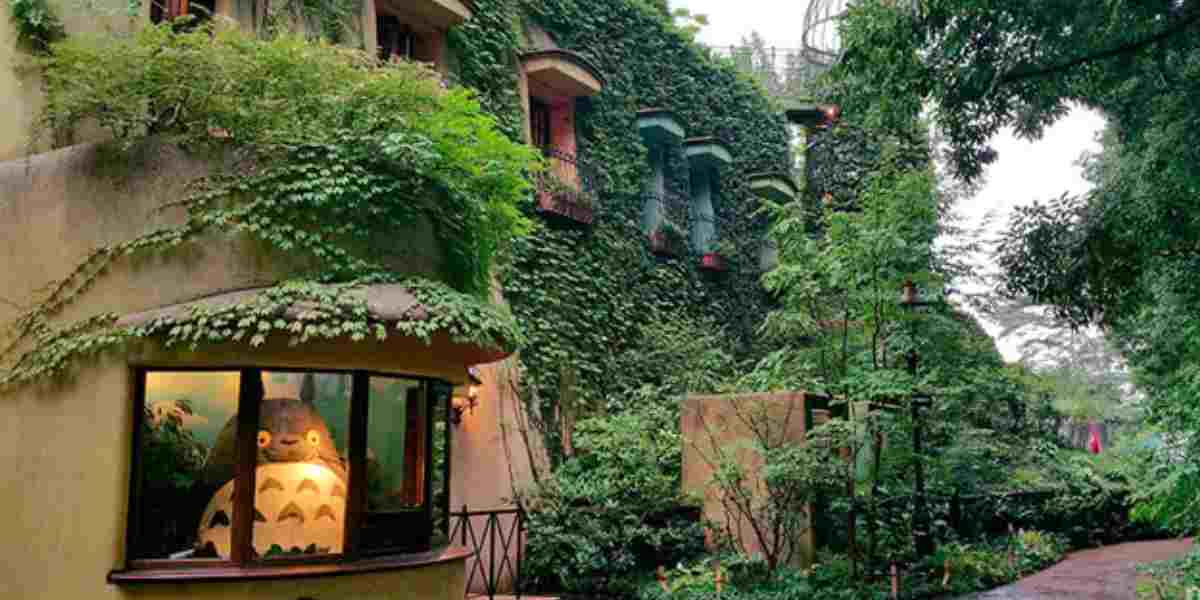
At first glance, the building looks like a cross between a Tuscan villa, a cottage from a children's picture book and one of Leonardo da Vinci's machines. Bright yellow façades, irregular windows, ivy, overflowing plants. Inside, the structure unfolds over several levels connected by wrought-iron spiral staircases, footbridges and overhanging balconies. The building's height is disguised by its fragmentation: you climb without realizing it.
In its own words, the museum combines three identities that are usually kept separate: a children's museum (interaction, play, hands-on), a museum of technique (the mechanics of animation, optics, movement), and a fine arts museum (original drawings, storyboards, layouts, paintings). This threefold nature explains its unclassifiable tone — neither purely childlike, nor purely academic, nor purely contemplative.
A telling detail: Miyazaki insists that the building itself is part of the exhibition. The walls, the corridors, the stained-glass windows depicting Ghibli characters, the great glass roof — everything contributes to the message. To visit the Ghibli Museum is to walk through a work — not to look at works in a neutral container.
The signature spaces
Without imposing a route, the museum gathers a few spaces that every visitor will come across sooner or later. From a heritage point of view, each deserves particular attention.
"Where a Film is Born" — permanent exhibition
On the first floor, a series of rooms faithfully recreates a traditional animation studio : Miyazaki's desk cluttered with pencils and sketchbooks, shelves of reference books, storyboards, layouts, background paintings in gouache, settei and cels. In the whole museum, this is the room most directly aimed at anyone interested in the production pipeline: here, staged but authentic, is the craft of making an animated film.
The giant Catbus
A life-size replica of the Catbus from My Neighbor Totoro (1988), open to children only. A deliberate curatorial gesture: there is an area of the museum that adults cannot enter. A striking reversal of ordinary museum conventions.
The robot soldier on the roof
On the planted rooftop terrace stands the life-size statue of the robot soldier from Castle in the Sky (1986) — a five-meter bronze sculpture, among the museum's figures most photographed by visitors (outdoors, where photography is allowed). At its feet, a cube-shaped stone block engraved with Laputan script completes the scene.
The bookshop and the café
The "Mamma Aiuto" shop (a nod to Porco Rosso) and the museum's reading room offer a carefully chosen selection: books on animation, children's books recommended by Ghibli, art books and fine illustrated volumes sometimes unavailable elsewhere. The "Straw Hat" café serves simple food inspired by the studio's meals.
The Saturn Theater and its exclusive short films
On the lower floor, in a small theater of about eighty seats with a ceiling painted as a flowered blue sky, is the Saturn Theater (土星座, Doseiza). It is the heritage heart of the museum — the only theater in the world where certain Ghibli short films are screened, never distributed anywhere else.
The program rotates among about nine titles, screened according to a schedule published by the museum. Among the most notable:
- Mei and the Kittenbus (めいとこねこバス, 2003) — the official sequel to My Neighbor Totoro, never released in theaters or on video.
- Boro the Caterpillar (毛虫のボロ, 2018) — Miyazaki's first short film in more than five years at the time, premiered exclusively at the Saturn.
- The Day I Bought a Star (星をかった日, 2006), House Hunting, Mon Mon the Water Spider, and several other titles directed by Miyazaki or by the studio's young talents.
The heritage stakes are high: these films exist nowhere else. Not on streaming, not on Blu-ray, not at festivals, not even in Japanese collector's box sets. The only way to see them is to come to Mitaka. The gesture is radical and meaningful: Ghibli deliberately chooses not to exploit part of its catalog commercially, and makes it the reward for a physical journey. The museum thus becomes the guardian of a body of work that nothing else distributes.
At the end of the film, a touch staged by Miyazaki: the theater's windows open and daylight floods in. A purely cinematic gesture — the end of the screening as a return to the world.
The film-strip ticket — a heritage gesture
Here is the detail that, on its own, would justify SAKUGAART's attention to this museum: the admission ticket each visitor receives is a genuine fragment of 35mm film, cut from an authentic Ghibli film print. At the entrance, a staff member exchanges the printed booking voucher for this strip of three or four frames slipped into a card sleeve. On the spot, you can hold your ticket up to the light to discover which images you received — a character from Totoro, a shot from Princess Mononoke, a cloud from Spirited Away.
The gesture carries a philosophical weight that goes beyond a tourist souvenir. It says three things at once.
First, it makes animation physical — it reminds us that cinema, before it was a digital file, was a chain of physical objects, from painted cels to projected film. As its ticket, the Ghibli Museum gives every visitor a fragment of this vanished materiality, precisely at the time it was disappearing from industrial practice. It is the transition from cels to digital, condensed into a ticket-desk gesture.
Second, it gives each visitor a unique piece : the ticket cannot be reproduced, differs from every other, and carries at random a few seconds of a film that no other visitor will own. The museum makes each admission a one-of-a-kind object.
Finally, it transforms the souvenir. Where most museums sell mass-produced merchandise, Ghibli gives everyone a fragment of the work itself. It is no longer a memento of a visit: it is a shard of the film, taken home.
The Ghibli Museum does not sell souvenirs — it gives every visitor an authentic fragment of cinema.
Mitaka Museum vs. Ghibli Park in Aichi — don't confuse them
Since November 1, 2022, Studio Ghibli has had a second physical site in Japan: Ghibli Park (ジブリパーク), located in the Expo 2005 Commemorative Park in Nagakute, Aichi Prefecture, near Nagoya — more than 250 kilometers from Mitaka. The two sites are regularly confused in the press. They are not the same thing, and telling them apart is the mark of a serious article.
| Criterion | Ghibli Museum (Mitaka) | Ghibli Park (Aichi) |
|---|---|---|
| Opening | October 1, 2001 | November 1, 2022 |
| Location | Western suburbs of Tokyo (Inokashira Park) | Near Nagoya (Expo 2005 park) |
| Nature | Museum of art, animation and technique | Open-air theme park, several areas |
| Scale | Intimate, ~2,400 visitors/day | Large, ~3,500 to 4,000 visitors/day for the Grand Warehouse alone |
| Design | Hayao Miyazaki in person (through storyboards) | Goro Miyazaki, project director |
| Movie theater | Saturn Theater (lower floor, 80 seats) | Cinema Orion — other exclusive short films |
| Approach | Contemplative, art, the creative process | Immersive, living inside the films' settings |
For a fan or a student of animation heritage, the two sites are not interchangeable — they are complementary. The Mitaka museum is devoted to animation as art and as technique; the Aichi park is devoted to animation as an immersive world. And their respective exclusive short films are, in both cases, different and not interchangeable.
Practical information (as of 2026)
Every visit to the Ghibli Museum takes preparation. The rules are strict and rarely bent. The following is given for guidance; SAKUGAART always recommends checking the official website ghibli-museum.jp before booking, as arrangements change.
Admission
Admission fees, set by age group, are deliberately kept low in view of worldwide demand, by the museum's own choice. Current rates are listed on the official website.
Booking
No tickets are sold on site. Booking is mandatory and is done exclusively through Lawson Ticket, the ticketing service of the Lawson convenience-store chain. Tickets for a given month go on sale on the 10th of the previous month, at 10 a.m. Japan time (JST) . They sell out in minutes — sometimes seconds for the most popular slots. There are four time slots a day. Resale is prohibited, and tickets bought on third-party platforms may be refused at the entrance.
Getting there
Nearest station: Mitaka (JR Chūō Line, ~15 min from Shinjuku) — a 15- to 20-minute walk through Inokashira Park. Alternatively, Kichijōjistation, a 25-minute walk through the same park — a route many prefer for the stroll. A yellow community shuttle bus connects Mitaka station to the museum in five minutes.
On site
Allow two to three hours for the visit (the building is compact but dense). Photography is forbidden inside, but allowed on the roof and around the robot. Admission includes a ticket for the Saturn Theater — one screening per ticket.
A heritage reading of the museum
Beyond the tourist fact sheet, the Ghibli Museum deserves, for anyone interested in the heritage of Japanese animation, a critical reading in three points. What makes it unique is not its success — it is its stance.
First, it is a museum that resists commercialization. Capacity is limited to 2,400 visitors a day when worldwide demand would be a hundred times greater. Prices are kept low. Photography is forbidden inside. The Saturn Theater's short films are not exploited commercially. All these decisions run counter to obvious economic logic, and reflect a conception of heritage as something to protect, not to maximize.
Second, it is a museum that puts forward a thesis on animation. By devoting an entire floor to the craft of making — the animator's desk, layouts, settei, cels — and by screening short films rather than selling merchandise, the museum asserts that animation is an art of production, not only an art of reception. This is Miyazaki's auteur vision, exhibited as an architectural manifesto.
Third, it is a museum that embodies a transition. The film-strip ticket, the care given to the cels on display, the respect for paper in the recreated studios: all of this speaks, between the lines, of an era coming to an end. The museum opened in 2001, roughly when Japanese animation was switching wholesale to digital for coloring and compositing. Sazae-san remained the last TV series made on physical cels until September 29, 2013. In this context, the Ghibli Museum is less a showcase of contemporary animation than a conservatory — a place that preserves, for those willing to come and see it, the handcraft of an animation that has now largely disappeared.
Related articles on SAKUGAART
- The feature on the Japanese animation production pipeline — to understand what the recreated "Where a Film is Born" studio shows.
- The profiles of Hayao Miyazaki, Isao Takahata, Toshio Suzuki — Ghibli's founders.
- The entry on Studio Ghibli and the entry on Topcraft — Ghibli's predecessor studio.
- Coming soon: a feature on the short films of the Saturn Theater · a feature on Ghibli Park in Aichi · a feature on the transition from cels to digital at Ghibli.
Sources & references
- Official website — Ghibli Museum, MitakaPrimary source · tickets · films · opening hours
- Wikipedia — Ghibli MuseumOrigins · Calcata · Keisuke Tanaka
- Saturn Theater — programCatalog of exclusive short films
- Tickets — official arrangementsLawson · the 10th of the month · rules
- Comparison: Museum vs. Ghibli ParkMitaka / Aichi distinction · differences
Methodological note. History (opened October 1, 2001, planned from 1998, designed by Hayao Miyazaki through storyboards with architect Keisuke Tanaka, inspired by Calcata), nature (Mitaka Municipal Animation Museum, Inokashira Park), capacity (~2,400 visitors/day, ~650,000/year), philosophy ("Let's get lost together," no photography inside), Saturn Theater (~80 seats, exclusive short films in rotation including Mei and the Kittenbus, Boro the Caterpillar, The Day I Bought a Star), authentic 35mm film-strip ticket, booking arrangements (Lawson Ticket, the 10th of the previous month at 10 a.m. JST) and the distinction from Ghibli Park in Aichi (opened November 1, 2022): facts established by cross-checking converging sources (official website, Wikipedia, several specialized guides cited). Opening hours and booking rules are the most recent available at the time of writing — always check ghibli-museum.jp before traveling. Article written for SAKUGAART, an editorial site devoted to Japanese animation.