


Spotted an error? Did you work on this production, or do you keep a memory or a document from it? We would be glad to hear from you.
Creator portrait · Tribute · 1939-2026
Tetsuya Chiba,
the artist of Ashita no Joe
ちばてつや · 千葉徹彌 · あしたのジョー · 一九三九 ― 二〇二六
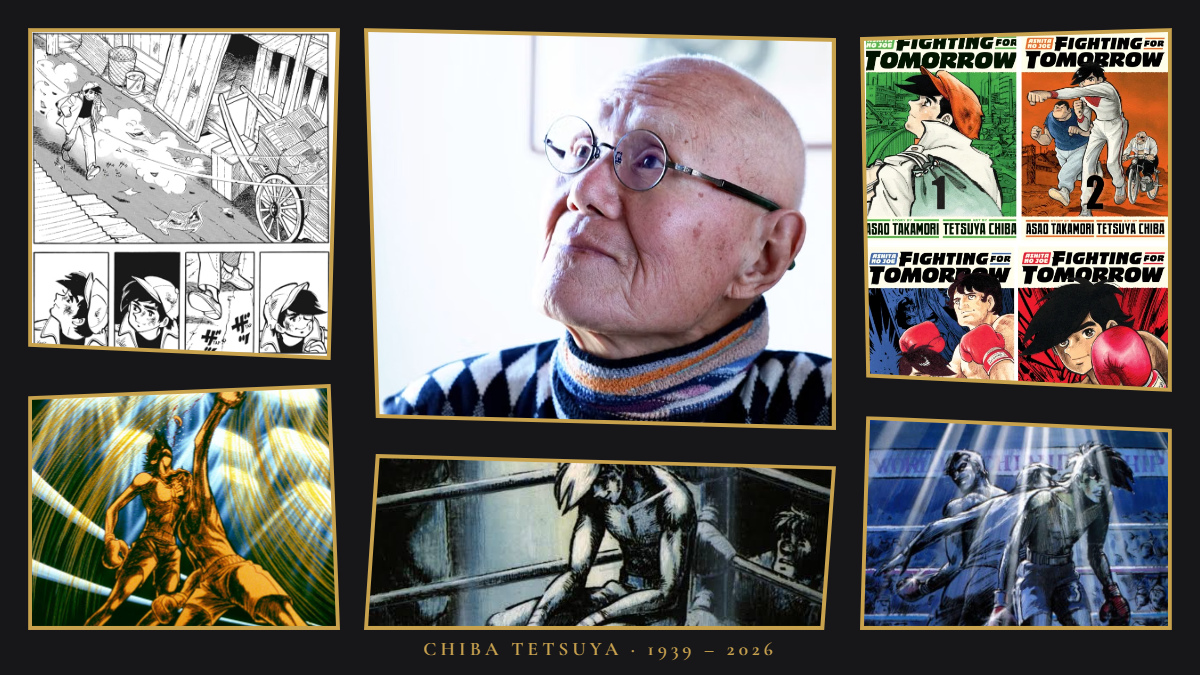
The artist of Ashita no Joe died on 22 October 2026 in a Tokyo hospital, aged eighty-seven; the news was made public on 27 October. A child repatriated from Manchuria, a beginner in the rental books of the 1950s, an author of girls' manga before he became the painter of battered bodies in boxing, sumo and kendo, Tetsuya Chiba spanned seventy years of Japanese comics. In 2024 he became the first manga artist to receive the Order of Culture. This portrait traces his life, his work, its animated adaptations and his place in France.
22 October 2026
Tetsuya Chiba died on 22 October 2026 at 6 p.m. in a Tokyo hospital. His family announced it on 27 October on his official website, and the news was relayed the same day by his two historic publishers, Kōdansha and Shōgakukan. The funeral was held privately with the family; the family asked that people refrain from condolence visits, flowers and telegrams. A farewell ceremony is under consideration, with no date set.
The statement is signed by his wife, Yukiko (幸子), chief mourner, who thanks the relatives and readers who supported him throughout seventy years of work.
「…漫画家として本当に幸せな人生でした。」
"… for a manga artist, it was a truly happy life."
— From the family's message published on Tetsuya Chiba's official website, 27 October 2026, quoted by Crank-in! (SAKUGAART translation)
His last series, Hinemosu notari nikki (ひねもすのたり日記), published since December 2015 in Shōgakukan's Big Comic, had been suspended in September 2026 for health reasons, after a first break from August to December 2024 following an operation on his left eye; the editors said at the time that they wanted to give priority to his recovery, and the author had expressed the wish to take up his pen again.
Tsukiji, Mukden, the return
Tetsuya Chiba was born on 11 January 1939 in Tsukiji, in what is now Chūō ward, Tokyo; his legal name is written 千葉徹彌. In 1941 the family left for Mukden (Fengtian, now Shenyang), in north-eastern China, then under Japanese rule, where his father worked at a paper mill.
The defeat of 1945 overturned his childhood. The family found refuge in the attic of a colleague of his father, then returned to Japan in 1946 through the port of Maizuru, at the end of a repatriation the author would recount all his life. Two of his younger brothers also became manga artists: Akio Chiba, and Shigeyuki Chiba, who signs his sports manga as Tarō Nami.
This experience of children left to fend for themselves runs through his work. Asked about the model for Joe Yabuki, he replied that there was not one but thousands.
「誰をモデルということではなく、本当にそういう人たちはたくさんいた。あしたのジョーのように親がいない、自分の出生が分からない、戦災孤児みたいな人はたくさんいた」
"It is not that I took someone as a model: there really were many people like him. Without parents like Joe, without knowing where they came from, war orphans, there were a great many of them."
— Tetsuya Chiba, aged seventy-six, quoted by ABEMA TIMES and TV Asahi, 28 October 2026, Japan time (SAKUGAART translation)
From rental books to magazines
Still a schoolboy, Chiba joined an amateur circle, the "Manga Club", in 1950. In 1956 he published his first book, Fukushū no semushi otoko (復讐のせむし男), in the rental book circuit (kashihon), volumes lent out for a few days that fed working-class youth at the time. In 1958 he moved to magazines with Butōkai no shōjo, in Shōjo Book.
In the 1960s he worked simultaneously for boys and for girls, a rare versatility. For Shōjo Club and Shōjo Friend he drew 1·2·3 to 4·5·roku (1962), Misokkasu (1966-1967) and Akane-chan (1968). For Kōdansha's Weekly Shōnen Magazine he illustrated Chikai no makyū (1961-1962), a baseball story written by Kazuya Fukumoto, then created Shidenkai no taka (1963-1965), about a young fighter pilot in the Pacific War, and Harris no kaze (ハリスの旋風) (1965-1967), whose brawling hero foreshadows Joe.
| Years | Work | Magazine | Note |
|---|---|---|---|
| 1956 | Fukushū no semushi otoko | Rental book | First book |
| 1958 | Butōkai no shōjo | Shōjo Book | Magazine debut |
| 1961-1962 | Chikai no makyū | Weekly Shōnen Magazine | Story by Kazuya Fukumoto |
| 1963-1965 | Shidenkai no taka | Weekly Shōnen Magazine | War story |
| 1965-1967 | ★Harris no kaze | Weekly Shōnen Magazine | Adapted as an anime (1966) |
| 1966-1967 | Misokkasu | Shōjo Friend | Shōjo |
| 1968-1973 | ★★Ashita no Joe | Weekly Shōnen Magazine | Story by Asao Takamori |
| 1973-1980 | ★Ore wa Teppei | Weekly Shōnen Magazine | Kendo · Kōdansha Culture Award 1976 |
| 1973-1998 | ★Notari Matsutarō | Big Comic | Sumo · Shōgakukan Award 1977 |
| 1981-1991 | Ashita tenki ni nāre | Weekly Shōnen Magazine | Golf |
| 1992-1994 | Shōnen yo raketto o idake | Weekly Shōnen Magazine | Tennis |
| 2015-2026 | Hinemosu notari nikki | Big Comic | Autobiographical story |
Ashita no Joe (1968-1973)
While researching Harris no kaze, Chiba became interested in boxing. The editors of the Weekly Shōnen Magazine then paired him with Ikki Kajiwara (梶原一騎), the writer of Kyojin no hoshi, who was looking for an artist for a boxing project and used the pen name Asao Takamori (高森朝雄) for the occasion. Chiba would later say he came to what he thought was a simple meeting, only to find that everything had already been decided.
The series ran from the issue dated 1 January 1968, on sale on 15 December 1967, to the issue of 13 May 1973. Joe Yabuki, a brawling orphan from the Tokyo slums, is spotted by Danpei Tange, a washed-up former boxer, and discovers boxing in a reformatory, facing Tōru Rikiishi. The manga invents a boxing of flesh and attrition, in which every victory costs a piece of the body.
A fiction that spills over into reality
The death of Rikiishi, after his fight against Joe, caused real mourning: on 24 March 1970 a funeral was held for the character in the Kōdansha hall in Bunkyō, organised by the Tenjō Sajiki theatre troupe on an idea of the poet and playwright Shūji Terayama. A week later, on 31 March 1970, the hijackers of the Yodo flight, members of the Red Army Faction, left a statement that closed with a sentence that became famous.
「われわれは明日のジョーである」
"We are tomorrow's Joe."
— Statement by the Yodo flight hijackers, 31 March 1970, quoted by the Japanese encyclopedia, article あしたのジョー (SAKUGAART translation)
The final image, Joe sitting in his corner after the fight against José Mendoza, reduced to "pure white ash" (真っ白な灰), has fuelled debate among readers for more than half a century: is Joe dead?
Joe on screen
Two television series, both directed by Osamu Dezaki (出﨑統), fixed the animated image of Joe. The first, produced by Mushi Production, the company founded by Osamu Tezuka, was broadcast by Fuji TV from 1 April 1970 to 29 September 1971: seventy-nine episodes, with Akio Sugino as chief animator, ending with the fight against Carlos Rivera. Shingo Araki was one of its animation directors.
Ten years later, Tokyo Movie Shinsha took the story to its end with Ashita no Joe 2, broadcast by Nippon TV from 13 October 1980 to 31 August 1981 in forty-seven episodes. Two compilation feature films were released in 1980 and 1981.
| Date | Work | Production | Format |
|---|---|---|---|
| 1970-1971 | ★★Ashita no Joe | Mushi Production · dir. Osamu Dezaki | 79 episodes · Fuji TV |
| 8 March 1980 | Ashita no Joe (film) | Compilation of the first series · Nippon Herald | 152 min |
| 1980-1981 | ★★Ashita no Joe 2 | Tokyo Movie Shinsha · dir. Osamu Dezaki | 47 episodes · Nippon TV |
| 4 July 1981 | Ashita no Joe 2 (film) | Compilation of the second series | 114 min |
| 11 Feb. 2011 | Ashita no Joe | Live-action film, starring Tomohisa Yamashita | Cinema |
| 2018 | Megalo Box | Futuristic reimagining for the manga's fiftieth anniversary | Animated series |
After Joe: sumo, kendo, golf and memory
With Joe finished, Chiba immediately began two series that he ran side by side for almost seven years. Ore wa Teppei (おれは鉄兵), about a wild boy thrown into school kendo, appeared in the Weekly Shōnen Magazine from August 1973 to April 1980 and received the Kōdansha Culture Award in 1976. Notari Matsutarō (のたり松太郎), the chronicle of an indolent giant in the world of sumo, ran in Shōgakukan's Big Comic from 1973 to 1998; it earned him the Japan Cartoonists Association Special Award and the Shōgakukan Manga Award in 1977.
Golf followed with Ashita tenki ni nāre (1981-1991) and tennis with Shōnen yo raketto o idake (1992-1994). After a long break, he returned in December 2015 with Hinemosu notari nikki, a drawn autobiographical chronicle. The series has been published in French by Vega, under the title Journal d'une vie tranquille.
Mentor and honours
As early as 1980, Kōdansha created the Tetsuya Chiba Award in his name, to discover young authors; on announcing his death, the publisher recalled how many artists had entered the profession with his encouragement. In July 2012 he succeeded Takashi Yanase, the creator of Anpanman, as head of the board of the Japan Cartoonists Association, of which he became president in June 2018. From 2019 to 2022 he was president of Bunsei University of Art.
The honours followed the public recognition of manga itself. In 2022 he entered the Japan Art Academy, in the same intake as Yoshiharu Tsuge, the first two manga authors put forward for the institution. On 25 October 2024 the government announced that he would receive the Order of Culture: he was the first manga artist so honoured, and the decoration was presented to him at the Imperial Palace on 3 November 2024.
| Year | Honour | For |
|---|---|---|
| 1962 | Kōdansha Children's Manga Award | — |
| 1976 | Kōdansha Culture Award | Ore wa Teppei |
| 1977 | Japan Cartoonists Association Special Award | Notari Matsutarō |
| 1977 | Shōgakukan Manga Award (23rd edition) | Notari Matsutarō |
| 2001 | Minister of Education Award | Sports manga for young readers |
| 2002 | Medal with Purple Ribbon | Body of work |
| 2012 | Order of the Rising Sun, Gold Rays with Rosette | Body of work |
| 2014 | Person of Cultural Merit | Body of work |
| 2022 | Member of the Japan Art Academy | — |
| 2024 | Kikuchi Kan Prize | — |
| 2024 | ★★Order of Culture | First manga artist so honoured |
France and the world
In France, Ashita no Joe long remained a legend known by hearsay: we found no trace of a television broadcast of the animated series, whereas Italy knew them as Rocky Joe. The manga finally appeared from Glénat, in thirteen volumes, from 2010 to 2012; in January 2011 it was included in the Heritage selection of the Angoulême festival, a category that honours reissues of classic works. Vega later published Journal d'une vie tranquille. In the United States, Kodansha USA launched the first English edition in December 2024.
On the announcement of his death, Glénat paid tribute to "a major figure in the history of Japanese manga", "one of the pioneers of modern manga", whose "artistic legacy will remain alive in every page he leaves us" (translated from French). Elsewhere, his drawings were shown in 2015 at the British Museum, lent by the author, in the exhibition Manga Now: Three Generations, and an image from Hinemosu notari nikki was still on display until 25 January 2026 in the Art of Manga exhibition at the de Young Museum in San Francisco.
Chronology
| Date | Event | |
|---|---|---|
| 11 Jan. 1939 | Born in Tsukiji, Tokyo | Japan |
| 1941 | Leaves for Mukden | Manchuria |
| 1946 | Repatriation to Japan | Japan |
| 1956 | First book, rental edition | Japan |
| 1958 | Magazine debut, Shōjo Book | Japan |
| 15 Dec. 1967 | ★★First chapter of Ashita no Joe (issue dated 1968) | Japan |
| 24 March 1970 | Funeral of Tōru Rikiishi at Kōdansha | Japan |
| 1 April 1970 | Animated series begins (Mushi Production) | Japan |
| 13 May 1973 | End of Ashita no Joe | Japan |
| 1973 | Ore wa Teppei and Notari Matsutarō begin | Japan |
| 1980 | Tetsuya Chiba Award created; Ashita no Joe 2 | Japan |
| 2010 | First French volume from Glénat | France |
| Jan. 2011 | Heritage selection at Angoulême | France |
| July 2012 | Heads the Japan Cartoonists Association | Japan |
| Dec. 2015 | Hinemosu notari nikki begins | Japan |
| 2022 | Japan Art Academy | Japan |
| 3 Nov. 2024 | ★★Presentation of the Order of Culture | Japan |
| Sept. 2026 | Last series suspended | Japan |
| 22 Oct. 2026 | ★★Dies in Tokyo, aged 87 | Japan |