


Spotted an error? Did you work on this production, or do you keep a memory or a document from it? We would be glad to hear from you.
Portrait · Art direction and design · Tōei Dōga · 1963-2008
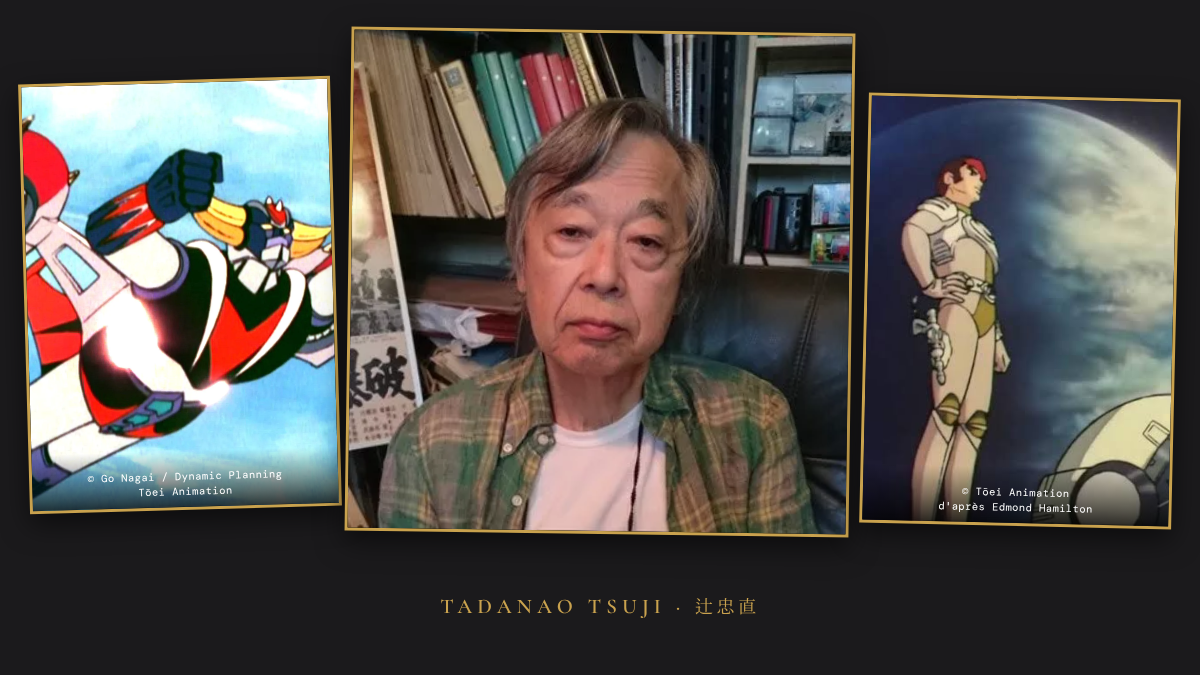
Tadanao Tsuji
辻 忠直
辻忠直 · 美術監督 · 美術設定 · メカデザイン · 東映動画
His name scrolls past in the credits of Mazinger Z, Grendizer, Captain Future, Yamato and Dragon Ball, yet almost no one knows him. Trained in the Tōei Dōga workshops in the early 1960s, Tadanao Tsuji spent more than forty years drawing the backgrounds, spaceships and machines in which the heroes of several generations lived. Built on the credits themselves, this portrait traces the career of an essential craftsman of Japanese animation.
A name in the credits: the craft of 美術
In Japanese animation, the term 美術 (bijutsu, "art") covers everything that is not a moving character: painted backgrounds, locations, architecture, overall colour and, often, the machines. The art director (美術監督, bijutsu kantoku) sets the style of the backgrounds and supervises their painting. The background designer (美術設定, bijutsu settei) draws the recurring locations and objects that every artist must then follow. The mechanical designer (メカデザイン) creates the robots, spaceships and vehicles.
Tadanao Tsuji practised all three crafts. According to the credits, he was in turn a background painter, colour designer, art director, background designer and machine designer, over almost half a century. This is a typical career for craftsmen trained at Tōei Dōga, where people moved from one post to another from production to production, and it is also why their names remain little known: lost in collective credits, rarely mentioned in the press, almost never interviewed.
The Tōei Dōga school (1963-1969)
The earliest trace of Tadanao Tsuji dates from 1963: he was an in-between artist on 『わんぱく王子の大蛇退治』 (The Little Prince and the Eight-Headed Dragon), Yūgo Serikawa's feature often cited as one of the peaks of Tōei Dōga's classical age. He soon moved to backgrounds: in 1965 he was a background painter on 『ガリバーの宇宙旅行』 (Gulliver's Travels Beyond the Moon). In 1966 he was colour designer (色彩設計) on the first Cyborg 009 film, then returned to backgrounds for Cyborg 009: Monster Wars (1967). In 1968 he took charge of colour again on 『アンデルセン物語』 (The World of Hans Christian Andersen).
These formative years exposed him to every skill of animation painting: drawing movement, composing backgrounds, managing colour. In television he became an art director very early: he is credited in that role on Rainbow Sentai Robin (1966), then on the series 『ひみつのアッコちゃん』 (Himitsu no Akko-chan, 1969), according to the animemorial database.
The Gō Nagai years (1970-1975)
In the early 1970s, Tsuji directed the backgrounds of action series such as 『キックの鬼』 (Kick no Oni, 1970) and some episodes of 『原始少年リュウ』 (Genshi Shōnen Ryū, 1971). He was also art director of the film 『魔犬ライナー0011変身せよ』 (1972). Then came the Gō Nagai wave, which would transform Tōei Dōga.
On the series Mazinger Z (1972-1974), the credits list three names for 美術: Tadanao Tsuji, Fumihiro Uchikawa and Makoto Yamazaki. The world of Mazinger, with its laboratories, coastal towns and undersea lairs, therefore owes him part of its atmosphere. He was art director of the Mazinger Z film released in 1973, then of two 1974 films: Getter Robo and 『マジンガーZ対暗黒大将軍』 (Mazinger Z vs. The Great General of Darkness). He then worked on the backgrounds of the series Getter Robo G (1975). The animemorial database also credits him with the art direction of Devilman (1972).
From Gattaiger to Grendizer
On 26 July 1975, as part of the Tōei Manga Matsuri programme, Tōei released a science-fiction short, 『宇宙円盤大戦争』 (Uchū Enban Daisensō, "The Great Space Saucer War"), directed by Yūgo Serikawa. Tsuji was in charge of its art. According to Japanese Wikipedia, he also designed the film's robot, Gattaiger, and its main machines, based on saucer sketches by Dan Kobayashi. The film became the pilot for UFO Robot Grendizer, known in France as Goldorak.
On the series, broadcast by Fuji TV from 5 October 1975, the credits list two "art designers" (美術デザイナー): Tadanao Tsuji and Iwamitsu Itō. Tsuji was also art director on several episodes. He thus took part in creating the visual universe of Grendizer, from the Shirakaba Ranch to the Space Science Research Institute, under the direction of Tomoharu Katsumata, who recounted those years to SAKUGAART in a documented interview.
Robots and racing cars (1976-1977)
After Grendizer, Tsuji established himself as one of Tōei's machine designers. In 1976 he signed the mechanical design of 『マシンハヤブサ』 (Machine Hayabusa), a motor-racing series built around its cars. The same year he was credited for art design on 『マグネロボ ガ・キーン』 (Magne Robo Ga-Keen), the second instalment, after Jeeg, of toy maker Takara's magnetic robot line.
In 1977 he combined mechanical design and art design on 『超人戦隊バラタック』 (Balatack), a robot assembled by five young pilots and the last instalment of the same Takara line. He also worked on the backgrounds of the motor-racing series 『アローエンブレム グランプリの鷹』 (Arrow Emblem: Hawk of the Grand Prix). These series gave him a rare double skill: he could draw both the world in which the heroes move and the machines that had to be able to become toys.
Captain Future: chief designer
In 1978, NHK and Tōei Dōga adapted Edmond Hamilton's novels as 『キャプテンフューチャー』 (Captain Future), broadcast in France as Capitaine Flam. Tsuji held a central place on it: he is credited as chief designer (チーフデザイナー), in charge of background design and mechanical design. He was reunited with director Tomoharu Katsumata and screenwriter Masaki Tsuji.
His best-known contribution is the Comet, the hero's ship, which the French version calls the Cyberlab. In the novels it is a teardrop-shaped rocket. According to the Japanese press, Tsuji redesigned it with the Discovery from 2001: A Space Odyssey in mind. He also designed the planets, bases and cities of the solar system, a more adult and more scientific universe than that of the robot series. In addition, he was art director of the special episode 「華麗なる太陽系レース」 (31 December 1978) and of the film version released on 17 March 1979.
「光と色彩に充ちた壮大なスケール感あふれる宇宙のビジュアル」: "images of space on a grandiose scale, full of light and colour."
— Ryūsuke Hikawa, animation critic, on Odin (1985), for which Tsuji was art director (Bandai Channel; SAKUGAART translation)
Yamato, Masuda and the great epics (1978-1985)
In the late 1970s, Tōei Dōga co-produced the films of the Yamato saga with Office Academy, the company of producer Yoshinobu Nishizaki. Tsuji took part in the background design of 『さらば宇宙戦艦ヤマト 愛の戦士たち』 (Farewell to Space Battleship Yamato, 5 August 1978), the first animated film in Japan to draw more than four million viewers. He worked again on the background design of 『ヤマトよ永遠に』 (Be Forever Yamato, 1980), then on the settings and design of 『宇宙戦艦ヤマト 完結編』 (Final Yamato, 1983).
At that time he worked with filmmaker Toshio Masuda, who came from live-action cinema. For Future War 198X (30 October 1982), directed by Masuda and Katsumata, Tsuji was art director and author of the original mechanical design: the machines of an imaginary Third World War, starting with the laser combat satellite at the heart of the plot. In 1985 he was art director of 『オーディーン 光子帆船スターライト』 (Odin: Photon Sailer Starlight), the space epic Nishizaki produced after Yamato, whose visions of space full of light and colour were praised by critics. Between two epics, he also directed the backgrounds of a fairy tale, 『世界名作童話 白鳥の湖』 (Swan Lake, 1981).
From Dragon Ball to Lupin III (1983-2008)
In the 1980s, Tsuji remained a sought-after art director in television. He is credited on Albegas (1983), Sasuraiger (1983) and 『夢戦士ウイングマン』 (Wingman, 1984), as well as on Moero Arthur (1979) and Hello! Sandybell (1981). In 1986 he was in charge of background design on the series Dragon Ball, according to the official page. Akira Toriyama's world, with its villages, deserts and islands, reached the screen with his help.
He stayed loyal to the saga: in 1996 he signed the art design of the film 『ドラゴンボール 最強への道』 (Dragon Ball: The Path to Power) and took part in Dragon Ball GT, then in 1997 in the new Dr. Slump series. That same year, 1996, he drew the background plans for the first Kindaichi Case Files film. In the 2000s he was still working on the background design of several productions, including two Lupin III TV films (Seven Days Rhapsody, 2006, and Sweet Lost Night, 2008). These are the last credits we have found.
Legacy and filmography
Tadanao Tsuji belongs to the generation of craftsmen trained at Tōei Dōga who carried the worldwide rise of Japanese animation without ever becoming its faces. The heroes he brought to the screen, Mazinger, Grendizer, Captain Future, the battleship Yamato and Son Goku, travelled around the world; his name stayed in the credits. Yet his Gattaiger, his Comet and his machines for Future War 198X show a signature: plausible, restrained machines, conceived as real technical objects.
Selected filmography
| Year | Work | Role |
|---|---|---|
| 1963 | The Little Prince and the Eight-Headed Dragon Film | In-betweens |
| 1965 | Gulliver's Travels Beyond the Moon Film | Backgrounds |
| 1966 | Cyborg 009 Film | Colour |
| 1966 | Rainbow Sentai Robin TV | Art direction |
| 1968 | The World of Hans Christian Andersen Film | Colour |
| 1969 | Himitsu no Akko-chan TV | Art direction |
| 1972 | ★Mazinger Z TV | Backgrounds (with F. Uchikawa and M. Yamazaki) |
| 1974 | Mazinger Z vs. The Great General of Darkness Film | Art direction |
| 1974 | Getter Robo Film | Art direction |
| 1975 | ★★Uchū Enban Daisensō Pilot film | Art direction, design of Gattaiger and the machines |
| 1975 | ★★UFO Robot Grendizer TV | Art design (with I. Itō), episode art direction |
| 1976 | Machine Hayabusa TV | Mechanical design |
| 1976 | Magne Robo Ga-Keen TV | Art design |
| 1977 | Balatack TV | Mechanical and art design |
| 1978 | Farewell to Space Battleship Yamato Film | Background design |
| 1978 | ★★Captain Future TV | Chief designer, background design, mechanical design |
| 1980 | Be Forever Yamato Film | Background design |
| 1981 | Swan Lake Film | Art direction |
| 1982 | ★Future War 198X Film | Art direction, original mechanical design |
| 1983 | Final Yamato Film | Settings and design |
| 1985 | ★Odin: Photon Sailer Starlight Film | Art direction |
| 1986 | ★Dragon Ball TV | Background design |
| 1996 | Dragon Ball: The Path to Power Film | Art design |
| 2006 | Lupin III: Seven Days Rhapsody TV film | Background design |
| 2008 | Lupin III: Sweet Lost Night TV film | Art design |