


Spotted an error? Did you work on this production, or do you keep a memory or a document from it? We would be glad to hear from you.
TECHNIQUES & MATERIALS — CEL — セル
The Cel (セル):
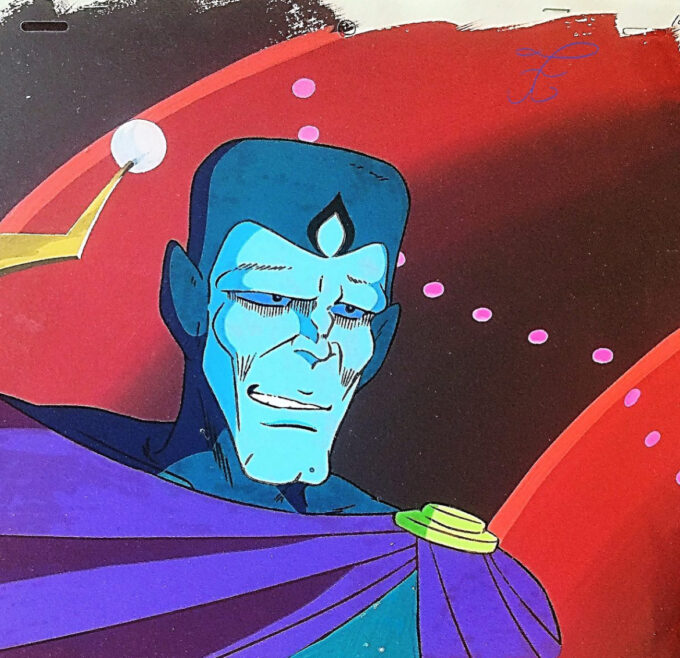
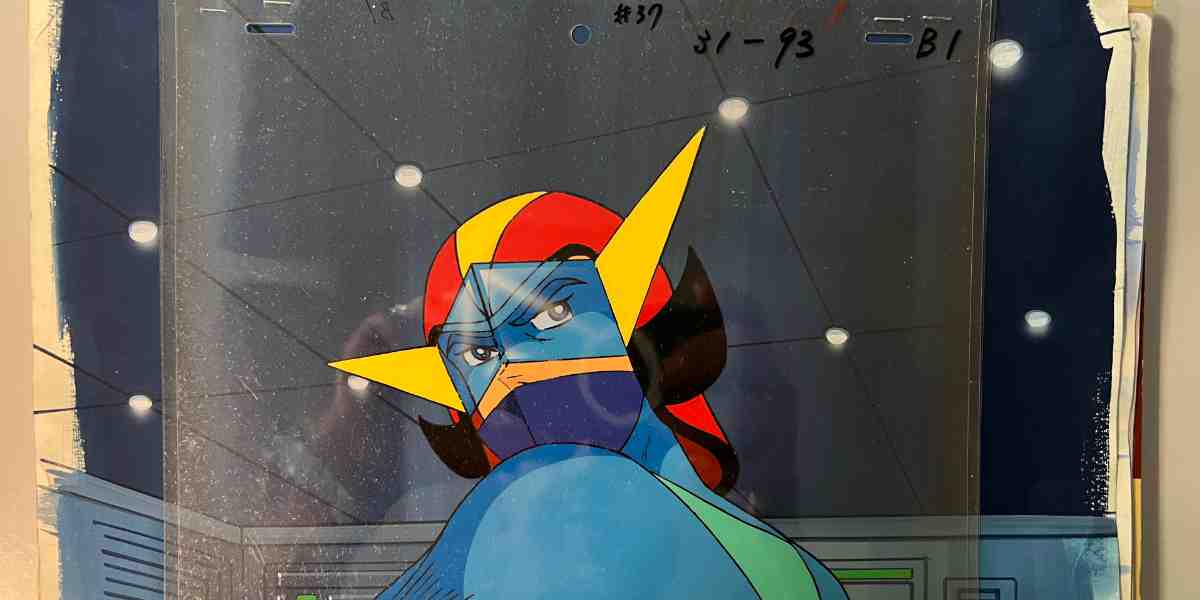
painting on acetate
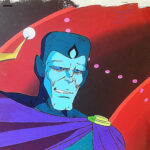
For half a century, Japanese animation rested on a material as fragile as it was revolutionary: the sheet of cellulose acetate, painted by hand and photographed shot by shot. From the Toei Doga of the 1960s to Sunrise's last cel productions in 1999, a complete anatomy of a vanished technique that founded the aesthetics of sakuga.
History and origins
The cel — in Japanese セル (seru), itself short for セルロイド (seruroido, celluloid) — is the transparent sheet on which the characters and foreground elements of an animated film are drawn and painted. For more than fifty years, this support was the basic material of animation worldwide, before being replaced by digital processes at the end of the 1990s.
The invention of the cel is credited to the American Earl Hurd, who filed the patent in 1914 and sold it to John Randolph Bray. The principle is radically elegant: separate the fixed background, painted on paper or board, from the moving elements (characters, props) painted on transparent sheets that are layered on top of it for filming. This breakdown eliminates the need to redraw the entire setting for every frame — a considerable saving of labor that made mass production industrially viable.
Before the cel: laborious animation on paper
Before 1914, animators — including Winsor McCay for Gertie the Dinosaur (1914) — drew every complete frame on paper, background included. A ten-second shot at 16 frames per second meant 160 complete drawings, each one redoing the same background in full. Hurd's patent made large-scale production possible within a few years.
In Japan, the cel was adopted gradually from the 1930s onward under the influence of American studios (above all Disney, whose films were shown in Japanese theaters). The Toei Doga studio (founded in 1956, now Toei Animation) was the first to truly industrialize Japanese cel animation production, on the Disney model, with Hakujaden (The Tale of the White Serpent, 1958), the first Japanese animated feature in color. It was not until Osamu Tezuka's TV series Tetsuwan Atom (Astro Boy) in 1963 that a distinctly Japanese production pipeline took shape — more economical in time and labor — which would become the industry standard.
For thirty years, cel sheets were in fact made of cellulose nitrate, a highly flammable material that was gradually replaced bycellulose acetate (acetate) from the 1950s and 1960s. Non-flammable and more stable, acetate became the world standard until the advent of digital.
Hurd patent
1914
Adoption in Japan
1930s–1940s
First Japanese color feature
Hakujaden, 1958
Gradual end of acetate
1996–2000
Making the support
The standard cel sheet in Japanese animation is a sheet of transparentcellulose acetate , with a thickness on the order of one to two tenths of a millimeter, cut to the dimensions of the shooting format used by the studio. These dimensions varied by studio, period and production; longer sheets were used for panning shots.
The blank sheet is almost perfectly transparent, with a slight bluish tint depending on the manufacturer. Blank sheets were supplied to studios by specialist manufacturers and distributors, then punched along one edge (the peg system, or peg system) to guarantee precise alignment when the layers are stacked.
The peg system (peg bar)
Cels are aligned by a system of metal pegs fixed to the animator's light table, to the tracing desk and to the rostrum camera. In Japan, this system is called tap (タップ); depending on the studio and the period, the holes are at the top or the bottom of the sheet, and there are most often two or three of them.
Format and camera field
The size of the sheet is directly tied to the image format captured by the rostrum camera. The Japanese standard TV field (TV safe) corresponds to a 4:3 image centered on the sheet, with safety margins on all four sides. The cinema field can cover a wider format (up to 16:9 or CinemaScope 2.35:1 in some productions of the 1980s and 1990s), in which case the sheet has to be larger to allow panning camera moves without leaving the usable field.
Painting by hand
Producing a finished cel takes several distinct steps, each entrusted to different specialists. The Japanese production pipeline developed a very precise, well-oiled division of labor that clearly separates the stages of tracing (トレス, toresu), checking (検査, kensa), painting (仕上げ, shiage) and final quality control.
-
01.
Tracing by hand or by machine (トレス, toresu) The final animation drawing, made on paper (douga, 動画), is transferred onto the front of the blank cel: by hand, in ink, until the 1960s and 1970s, then most often by a tracing machine using a xerographic process (トレスマシン). The paint is then applied to the back : seen from the front, the color shows through beneath the line, which stays sharp. This construction — line on the front, color on the back — is the optical foundation of the cel.
-
02.
Checking (検査, kensa) The drawings, and then the traced cels, are checked for line errors, omissions and variations in thickness. In the large studios (Mushi Production, Toei, TMS, Sunrise), this job was held by dedicated checkers, often among the most experienced staff.
-
03.
Applying the vinyl paints (shiage/仕上げ) The painter (shiage-man, overwhelmingly women in the Japanese industry) applies the paints by hand to the back of the cel. The paints are water-based vinyl paints (acrylic and vinyl polymers), opaque, in jars numbered according to each studio's own system. Colors are applied flat, without gradients, with a broad brush and then refined in the precise areas. No visible touch-up is acceptable, since every imperfection will be photographed.
-
04.
Drying and checking (shiage check) The painted cel must dry completely before being stacked with others — the risk of sticking or paint transfer is real. Quality control checks the flat areas (no bubbles, no visible brushstrokes, no color irregularities) and their conformity with the character's color sheet.
-
05.
Cleaning the front (cleaning) Before shooting, the visible front of the cel is cleaned with alcohol or an antistatic cloth to remove fingerprints, dust and particles that would appear as defects once photographed. This cleaning is repeated immediately before each take under the rostrum camera.
The characters' color palette: the settei
Every recurring character in a series has a standard color sheet (iro settei, 色設定), a reference document that precisely codifies every shade used, naming them by numerical codes that match the studio's paint jars. A main character can require up to 15 to 25 different colors for its light and shadow variants alone. To these are added contextual variants: night version, flash version, underwater version, backlit version.
On the major series of the 1980s (at Sunrise, for example, with Mobile Suit Gundam or City Hunter), color coding reached an almost industrial precision, with sheets distinguishing several levels of shade (normal color, shadow, deep shadow, highlight) for each color area of a character. The painter had to memorize these codes or keep them constantly at hand, since the slightest deviation showed on screen.
Special effects and advanced techniques
Some visual effects were achieved through specific painting and layering techniques. Halftones and transparency effects (explosions, flames, energy waves in science-fiction productions) were created on special cels painted with diluted paints or on partial color grounds, then photographed in multiple exposures.
The school of Yoshinori Kanada left its mark on the action animation of the 1980s with explosions and light effects built from geometric shapes and bright flat colors — effects drawn by the animators, then traced and painted on cels like the rest of the image.
Shooting under the rostrum camera
The painted cel is only raw material. Integrating it into the film requires an additional step that is a discipline in its own right: shooting under the rostrum camera (satsuei dai, 撮影台), also known as an animation stand .
The Japanese rostrum camera is a precision camera mounted vertically, pointing down at a flat, lit surface (shooting stand). On this surface, the operator (satsuei-man, the rostrum cameraman) stacks, in a calculated order:
-
01.
The background (haikei, 背景) Painted in gouache or watercolor on board or heavy paper, it forms the fixed base of the shot. The background artists (bijutsu-man) deliver backgrounds of often breathtaking precision and color richness — many of them trained at Japanese fine arts schools.
-
02.
Animated background cels (backgrounddouga ) Some background elements are themselves animated (clouds, water, smoke) and layered over the fixed background as separate cels.
-
03.
The main character cels Stacked in the layering order set by the layout. A complex shot can contain up to 7 to 9 cels at once — a physical and optical limit (beyond that, the accumulation of acetate creates a slight visible discoloration and affects depth of field).
-
04.
Effects cels (efekuto) Explosions, lights, rain, interference — made on additional cels with special paints, sometimes in multiple exposures.
The rostrum operator receives from the animation director an exposure sheet (タイムシート, taimu shīto) specifying, for each frame of the shot, the number of each cel to use, the layering order, any camera moves (zoom, pan on a multiplane stand), filters and optical effects, and the exposure.
The multiplane stand in Japan
Some Japanese productions used multiplane stands, inspired by the multiplane camera developed at Disney in 1937 (under engineer William Garity), which sets the image levels at different heights. Expensive and slow, these devices were reserved for a few prestige shots; most depth effects were achieved by other means.
For TV productions, budget constraints made the multiplane impractical: depth was simulated by simply moving background cels at different speeds (a technique known as manual parallax scrolling ).
Film stock and exposure precision
In Japan, rostrum shooting was done on motion-picture film, most often 35mm, mainly from Fujifilm and Kodak. The film's sensitivity required precise lighting of the stand: two symmetrical studio lamps lighting the surface at 45°, calibrated for perfectly even illumination with no stray reflections on the transparent acetate.
Control ofexposure was critical: each additional cel absorbs a fraction of the light, and the operator had to correct the exposure manually according to the number of stacked cels. This empirical compensation, passed on through experience rather than calculation, was among the most valuable skills of seasoned satsuei-man.
What is specific to the Japanese industry
Although the cel technique originated in America, the Japanese industry profoundly transformed and rationalized it to meet its own constraints — TV budgets far below Disney standards, weekly production schedules, highly specialized jobs. These adaptations gave rise to an original production pipeline, distinct from the Western model, which still defines the structure of Japanese animation studios today.
Limited animation and its implications for the cel
From 1963, the economic model of the Japanese TV series imposed what is known aslimited animation (limited animation): rather than animating at 24 drawings per second (animation "on ones"), Japanese TV series generally animate at 8 to 12 drawings per second (animation "on twos" or "on threes"), each drawing being photographed two or three times in a row. This drastic economy mechanically reduces the number of cels needed, but in return demands much more precise shot design: each cel has to "hold" visually on screen for longer.
The direct consequence for the painter is a heightened demand for consistency: a slightly uneven flat area would go almost unnoticed in a film at 24 drawings per second, but becomes perfectly visible and irritating when the cel stays on screen for two or three frames. Painters on Japanese TV series thus developed a particularly controlled brush technique, favoring broad, fluid strokes to avoid any unevenness in flat areas.
Subcontracting and its risks
The economic pressure of TV production led, from the 1970s, to an increasing share of cel production being subcontracted to other countries: first South Korea (around studios such as Hanho Heung-Up, DR Movie and Dong Yang), then Taiwan, mainland China and the Philippines. These subcontractors received the drawings by mail, produced the in-betweens (douga), tracing and painting, and sent the finished cels back by express delivery — a logistics cycle that caused constant tension whenever there was a delay.
International subcontracting raised a recurring problem of color consistency : the vinyl paints used in Korea or Taiwan were not identical to the standard Japanese brands. The exporting studios had either to send the paint jars along with the drawings — increasing the cost and weight of the shipments — or to maintain precise correspondence tables between Japanese references and local equivalents, with the attendant risk of color drift.
The central role of the painters
Cel production in Japan was, from the start, a predominantly female sector. At the peak of analog production (1970s–1990s), the paint departments of the major studios were overwhelmingly female, with young recruits, often straight out of high school, trained in-house over several months. This can be explained by both sociological factors (the work was seen as an extension of valued female manual skills) and economic ones (painters were paid less than male animators).
Yet their role was fundamental: a fast and precise painter processed a considerable volume of cels every day on simple shots, and their collective expertise guaranteed the visual consistency of a series over hundreds of episodes. The closure of the paint departments during the switch to digital meant the loss of a craft passed down through apprenticeship over several generations.
Conservation and degradation
The cellulose acetate cel is a chemically unstable material in the long term. Its degradation follows a process known as vinegar syndrome (vinegar syndrome), after the characteristic smell of acetic acid released as it decomposes. Accelerated by heat, humidity and fluctuations in humidity, this phenomenon inexorably leads to the destruction of the support if no conservation measures are taken.
The four stages of acetate degradation
Stage 0 (unaltered): perfectly flat, transparent and odorless sheet. Stable colors, sharp lines.
Stage 1 (onset of degradation): slight vinegar smell. Micro-wrinkling appears at the edges. The degradation is already irreversible, but cold storage slows it considerably.
Stage 2 (advanced degradation): strong smell, warping of the sheet, acetate crystals appearing on the surface. The paint begins to crack and flake off in patches.
Stage 3 (irreversible): brittle, fragile sheet, paint partly lost, image permanently compromised. High-resolution scanning becomes risky, as each handling can worsen the damage.
The storage conditions for acetate supports are well documented by specialist institutions, notably the Image Permanence Institute (Rochester, NY): cold and dry storage (moderate relative humidity, on the order of 30 to 50%), stable and away from light. These conditions, known as "cold storage," slow chemical degradation without stopping it altogether.
The reality of Japanese collections is often alarming. Most of the cels produced between the 1960s and the 1990s were stored in poor conditions — unheated warehouses, damp basements, cardboard boxes — or simply destroyed after use. The studios did not see their cel archives as heritage: they were a storage cost, not a cultural asset.
Cels "for sale" and their market
From the 1970s, part of the production cels was diverted to a collectors' market that developed in parallel. These cels offered for sale can be either authentic production cels resold directly, or certified reproductions (fukusei seru) made from the original drawings after production.
A collectors' circuit took shape in the 1980s and 1990s, first in Japan, then in Europe and North America. Cels from emblematic productions (Saint Seiya, Dragon Ball, Neon Genesis Evangelion) are now the subject of sustained international demand, which has also drawn the attention of museums.
This enthusiasm has also spawned a significant counterfeit market: fake cels presented as originals, undeclared reproductions sold as authentic. Expert assessment relies on several criteria: analysis of the support (type of acetate, period registration holes), type of paint (period vinyl vs. modern paint), line (ink vs. a digital copy printed on acetate) and documented provenance.
Recommended storage
Cold, dry (RH ~30–50%), dark
Acetate degradation
Irreversible, slowed by cold
The digital transition (1990–2000)
The transition from cel animation to digital processes took place in Japan over a decade, roughly between 1990 and 2000, at a different pace depending on the type of production and the size of the studio.
The transition was gradual and piecemeal. In the 1990s, some studios adopted coloring software (Toonz, developed by the Italian company Digital Video, was one of the first used in Japan) for high-end OVA productions, while keeping cel tracing and painting for TV series.
The definitive switch is often dated to 1997–1999, the period during which most of the major studios (Madhouse, Production I.G, Gainax, Bones) completed their migration to an entirely digital coloring workflow. Princess Mononoke (Ghibli, 1997) is an emblematic case of hybrid production: most of the shots were still hand-painted on cels, but part of the film was digitally colored and composited — a first for the studio.
Toonz and coloring software
The Toonz software (developed by the Italian company Digital Video, adopted by Ghibli from Princess Mononokeonward) scans the animation drawings, colors them digitally by flood fill within defined areas, and composites them with the scanned backgrounds. It physically replaces the cel and vinyl paint with their digital equivalent — coloring with a mouse or stylus on virtual layers. Studio Ghibli left the cel behind with My Neighbors the Yamadas (Isao Takahata, 1999), the studio's first feature made entirely digitally. Toonz is now distributed as open-source software under the name OpenToonz.
The digital transition brought considerable gains in speed and flexibility: instant color correction, no risk of badly applied paint, no more costs for blank cels and paints, the ability to change a shade across an entire production in one click. But it also brought documented aesthetic losses that purists and animation historians identify precisely:
-
01.
Loss of the brush's slight organic imperfection A vinyl flat area laid by hand has microscopic variations in thickness and texture which, captured on film, create a slight visual vibration on the surface, absent from perfectly uniform digital flats.
-
02.
The disappearance of film grain The grain of 35mm film, combined with the texture of the acetate and the paints, gave the traditional animated image a particular optical depth. Digital productions of the 1990s and 2000s sometimes suffer from a "too clean" look that, paradoxically, dates them faster.
-
03.
A more uniform color palette Vinyl paints of different brands and formulations produced slightly variable color results, creating an involuntary richness of color. Digital coloring radically standardizes the palette, at the cost of a slight loss of chromatic complexity in the transitional productions of 1998–2005.
The cel as a heritage object
Since the mid-2000s, the animation cel has gradually acquired the recognized status of a heritage object — at once an art object, a popular collectible and a historical document preserved in museums and archives.
Conservation institutions
In Japan, several institutions work to preserve and showcase animation cels. The Suginami Animation Museum (杉並アニメーションミュージアム, Tokyo), opened in 2005, is one of the few public museums that regularly displays original production cels under controlled exhibition conditions. The National Diet Library (国立国会図書館) holds archival collections related to the history of animation, although physical cels are underrepresented there compared with printed publications.
Outside Japan, museums and cinematheques now present Japanese cels in exhibitions devoted to animation. These presentations reflect the gradual recognition of Japanese animation as a legitimate visual art form, on a par with Western auteur cinema.
Preventive digitization
In the face of the irreversible degradation of the supports, several preventive digitization programs have been launched. High-resolution scanning of a cel — typically at 2,000 to 4,000 dpi in 48-bit color — captures all the visual information before the physical support deteriorates further. These RAW files run to several tens of megabytes per cel, posing considerable storage and indexing challenges for large collections.
In Japan, projects to archive the "intermediate materials" of animation (drawings, cels, backgrounds) have developed in recent years, with the support of theAgency for Cultural Affairs (文化庁); productions from the 1960s to the 1980s, whose supports are actively deteriorating, are given priority.
Cel aesthetics and nostalgia
Since the late 2010s, a retro aesthetic movement around the cel can be seen in animation worldwide. Some studios seek to reproduce digitally the characteristic effects of the cel: slight imperfections in flat areas, film grain, the warm color grading of the 1980s. This movement, noticeable especially in independent Japanese productions, reflects an aesthetic nostalgia that retrospectively values what the industry had abandoned for purely economic reasons.
More significantly, studios such as Ghibli kept drawing by hand while coloring digitally: the pencil stroke outlived the cel, and it is the pencil that continues to carry the aesthetics of sakuga.
Technical glossary
The following terms make up the basic vocabulary of cel production as it was used in the Japanese animation industry. Romanizations follow the modified Hepburn system.
SERU / セル
セル画 (seru-ga)
Sheet of cellulose acetate on which characters and animated elements are traced and painted. From the English word "cel" (itself short for "celluloid").
GENGA / 原画
原画 (genga)
Key drawing produced by the key animator. It shows the important positions of the movement (key poses). Not yet traced onto a cel.
DOUGA / 動画
動画 (dōga)
In-between drawings made on paper between the genga, and by extension the in-betweener's job (douga-man). Transfer onto the cel is a separate step, tracing (トレス).
SHIAGE / 仕上げ
仕上げ (shiage)
Literally "finishing." The stage of painting the cels and the painter's job (shiage-man). A critical step in the production chain.
HAIKEI / 背景
背景 (haikei)
Background painted on board or paper, over which the cels are layered. A separate job done by the background artists (haikei-man).
SATSUEI / 撮影
撮影 (satsuei)
Shooting under the rostrum camera. The satsuei-man is the operator who composes and photographs the final shots, with cels and backgrounds layered.
IRO SETTEI / 色設定
色設定 (iro settei)
A character's color sheet. A reference document coding each shade by paint-jar number, with its light, shadow and night variants.
PEG BAR
ペグバー / 位置決めピン
Bar of metal pegs ensuring precise alignment of cels and backgrounds. A fundamental technical standard that guarantees image stability.
FUKUSEI SERU
複製セル
Certified reproduction cel, made after shooting from the original drawings for sale to collectors. Distinct from the original production cel.
VINEGAR SYNDROME
ビネガーシンドローム
The chemical degradation of cellulose acetate by acid hydrolysis, producing acetic acid (vinegar smell). Irreversible.
ON TWOS / ON THREES
2コマ / 3コマ
Animation with 2 or 3 frames per drawing (that is, 12 or 8 distinct drawings per second instead of 24). An economical technique characteristic of Japanese limited animation.
LAYOUT / レイアウト
レイアウト (reiauto)
Composition plan for a shot, specifying framing, the position of characters and background, and camera moves. A reference document for the douga-man and the satsuei-man.