


Spotted an error? Did you work on this production, or do you keep a memory or a document from it? We would be glad to hear from you.
Akira
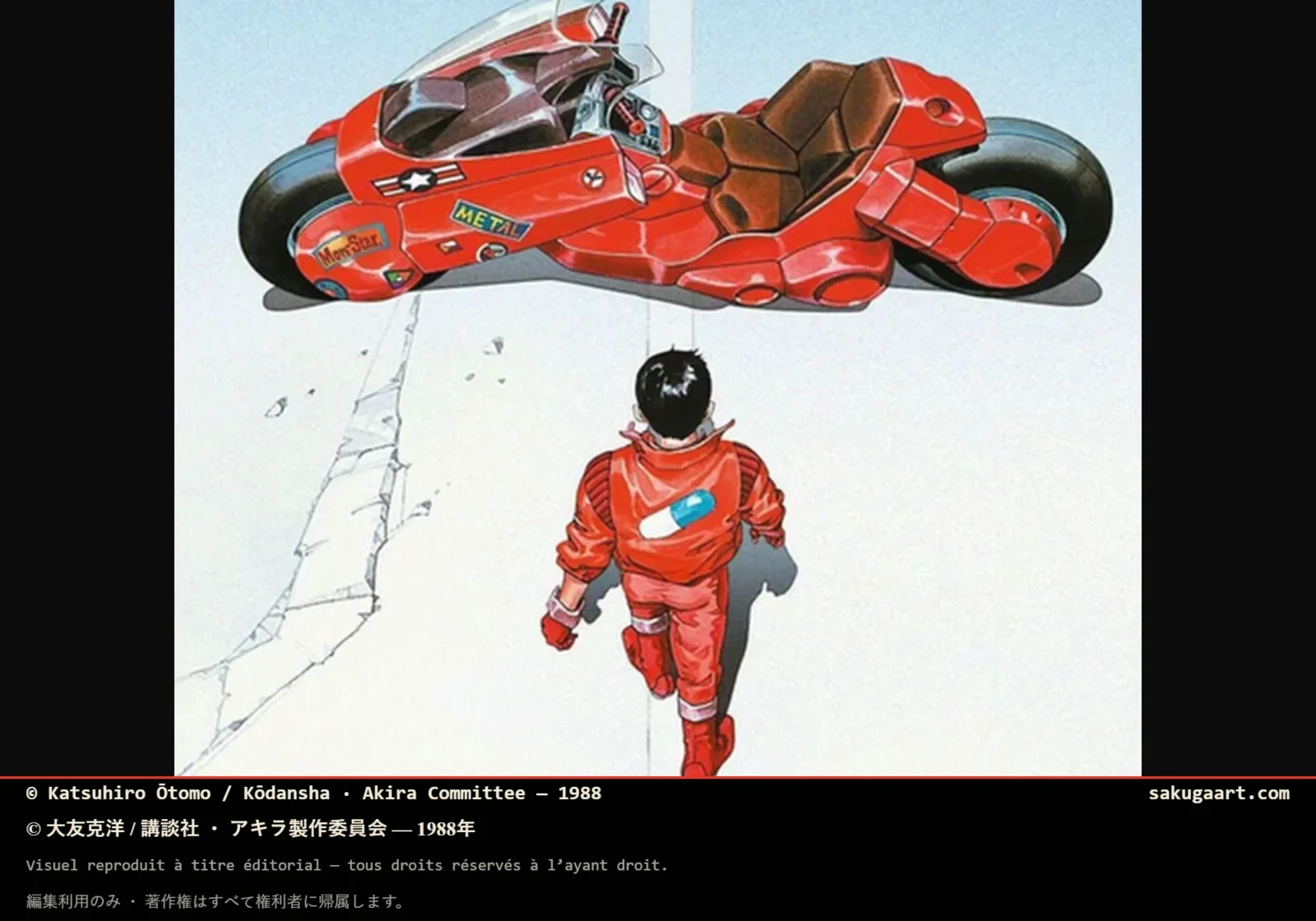
July 16, 1988. Toho opens a Katsuhiro Ōtomo film on 200 Japanese screens, with a budget that shatters every record in Japanese animation: 160,000 cels, 327 colors including 50 invented for the occasion, a score composed by a collective of several hundred singers, and a pre-recorded dialogue technique never before used in Japan. Akira is not just a film. It is the tipping point at which Japanese animation stops being a by-product of television and becomes a fully fledged cinematic work.
Distributed by Toho
Forum Distribution
Streamline Pictures
now TMS Entertainment
≈ $5.5M (1988)
production + promotion
2 to 3× the norm of the time
50 of them created from scratch
Weekly Young Magazine · 1982-1990
1988 theatrical run
some scenes beyond
Akira Committee
Before the film — an unfinished manga turned into a movie
In December 1982, Kōdansha asked Katsuhiro Ōtomo, then known for Dōmu, for a new science-fiction series for Weekly Young Magazine. The author first conceived Akira as a 200-page story to be wrapped up in six months. The series eventually ran to 2,182 pages published through 1990 — eight years of serialization whose ending was found, according to an often-repeated account, thanks to a late conversation with Alejandro Jodorowsky.
The setting grew from a simple intuition: transpose the atmosphere of postwar Japan into a dystopian future. Neo-Tokyo, a metropolis rebuilt on an artificial island after a mysterious explosion leveled Tokyo on December 6, 1982, is home to a contested government, idle biker gangs and military experiments on children with psychic powers. Ōtomo openly borrowed names from Tetsujin 28-go by Mitsuteru Yokoyama: Kaneda and Shikishima come from the 1956 manga, and Akira himself bears the number 28 in the line of government espers.
When the adaptation offer arrived around 1985, Ōtomo hesitated. He had already worked on the script and character design ofHarmagedon (Rintarō, 1983) and had mixed memories of it. He accepted on one condition: complete creative control. The decision had major consequences: adapting a work whose author did not yet know its ending meant writing the film's climax first, then working backward to the elements of the manga worth keeping.
This paradox gave rise to a lasting peculiarity ofAkira : two canonical versions of the same work coexist — the manga, which continued until 1990 with an expanded mythology, and the film, whose tighter ending takes liberties with the story published after 1988. Ōtomo often regretted the cuts imposed by feature length. Yet it is precisely this compression that gives the film its density.
Production — the committee, the budget, the crew
No Japanese studio of the 1980s had the means to finance such an ambition on its own. The anime business model then relied on television sponsorship, and animated feature budgets rarely exceeded ¥500 million — the previous record, Castle in the Sky by Miyazaki (1986), stood at that amount. For Akira, more than twice as much would be needed.
The solution took the unprecedented form of a consortium: the Akira Committee, a partnership of seven companies brought together to share the risk.
Rights holder · Young Magazine
Theatrical release in Japan
Executive production · now TMS
Television rights
Licensed products · toys · figures
Marketing campaign
Financial contribution · trading house
Budget — the figure and its late correction
For three decades, the ¥1.1 billion figure has circulated as one of the clinching arguments of the Akiralegend. Sources draw a precise distinction between two items: a production budget proper of ¥700 million, to which promotion costs were added to reach the ¥1.1 billion total. This figure was nonetheless partly disputed by one of the producers himself. In June 2020, Shigeru Watanabe published a clarification: the actual production cost reportedly matched the initial budget, with an overrun of about ¥100 million absorbed by the committee, but the total never actually reached ¥1.1 billion.
The debate illustrates an economic reality often obscured by legend: official anime budget figures frequently include promotion, distribution and financing costs — items the general public mistakenly equates with production alone. Whichever reading one adopts, Akira was, on its release, the most expensive Japanese animated film ever made, until Kiki's Delivery Service (Ghibli, 1989) surpassed it the following year on production budget alone.
The creative team
Several key animators deserve to be named: Makiko Futaki, who later joined Ghibli for Kiki (1989), Princess Mononoke (1997) and Howl's Moving Castle (2004), and who died in 2016; Satoru Utsunomiya, whose meticulous action scenes became a benchmark and who later joined Mamoru Oshii on Ghost in the Shell 2 and The Sky Crawlers ; Toshiyuki Inoue, who went on to Steamboy and then Satoshi Kon's films.
TMS mobilized more than sixty in-house key animators, and the credits list dozens of subcontracting studios — Oh Production, Gainax, Studio DEEN, Mook, Tezuka Production, Studio Pierrot, Kyoto Animation, Magic Bus — in other words, almost the entire Japanese animation ecosystem of the late 1980s was put to work on a single film.
Technique — the documented formal innovations
What sets Akira apart from the TV animation of its day is less a matter of isolated genius than of an accumulation of methodical innovations, each one costly, which together produce a sense of rupture. Four pillars define this technical singularity.
The number of cels
The film contains more than 160,000 cels. By comparison, a standard Japanese animated feature of the late 1980s used between 50,000 and 80,000. The doubling served a precise goal: to avoid the limited animation then ubiquitous on Japanese television. The animation inAkira is fully animated : every dynamic shot has its own drawings, with no wholesale recycling.
This density sometimes forced the animators to stack up to nine layers of transparent cels per shot, in order to handle light sources, particles, gunfire, motorcycle flares and the neon signs of Neo-Tokyo independently. Art director Toshiharu Mizutani oversaw background work in which every lit window of a building was painted individually.
The 327-color palette
1980s anime used a standard color library of about 60 shades. For Akira, color coordinator Kimie Yamana and her team raised that number to 327 distinct colors, about 50 of them created specifically for the film — pigments developed to meet the demands of a story set mostly at night.
The challenge lay in the very nature of the setting: Neo-Tokyo is seen mainly at night, bathed in neon. A rich night palette demands deep blues, violets, toxic greens and saturated reds able to hold their intensity under several layers of cels. The 50 new colors were designed to give an apparent fluorescence, color stability under camera lights, and the ability to catch light differently from one layer to the next. On the cels themselves, airbrush was used for luminous gradients — a rare method in Japanese animation. The halos of headlights, Tetsuo's psychic auras and the reflections on Kaneda's helmet are the result of this manual airbrush work applied directly to the cel.
Pre-recorded voices
Japanese animation traditionally usesafureko (after-recording): the animation is drawn first, and the actors then record their lines while watching the finished picture. For Akira , Ōtomo insisted on pre-recording (prelay), the reverse of standard practice and then almost unheard of in Japanese anime: the voices are recorded before the animation, and the animators then draw the mouths and expressions to match the actors' actual vocal performance.
The result: lip movements aligned with the breaths, pauses and nuances of the performance, something usually associated with Western animation. The cost of this reversal was considerable: it required first designing an animatic precise enough for the actors to play their parts at the right pace, then animating every shot in strict accordance with the soundtrack. For later foreign-language dubs, this lip precision became a trap — adapters often sacrificing translation accuracy to match the mouth movements.
The first uses of computer graphics
Akira incorporates computer graphics, still discreetly but in a documented way. Three contractors are credited: High-Tech Lab. Japan Inc., Sumisho Electronic Systems and Wavefront Technologies (an American company whose software would later lead to Maya). CGI was never meant to replace cels: it served as a precision tool for effects impossible to draw by hand — analysis monitors displaying psychic waves, physical trajectories of falling objects, parallax effects on some backgrounds, lens flares in post-production.
The animators also used a Quick Action Recorder, a device for quickly digitizing key drawings and viewing them at 24 fps before the coloring stage. The innovation is invisible on screen, but it changed the production chain: problems with the flow of motion could now be spotted before the final cels were painted.
The score — Geinoh Yamashirogumi
Ōtomo's musical choice has no equivalent in Japanese animation. Rather than entrust the score to a film composer, he turned to a scientific musical collective founded in 1974 by Tsutomu Ōhashi under the pseudonym Shōji Yamashiro: Geinoh Yamashirogumi (芸能山城組). The collective brings together several hundred members from eclectic backgrounds — journalists, doctors, engineers, students — united by an approach of experimental ethnomusicology that seeks to recreate traditional music from around the world, then hybridize it with contemporary electronic tools.
Ōtomo placed the order with two opposite constraints: a six-month deadline and total artistic freedom. The sonic identity blends Indonesian gamelan — with Balinese jegog at the heart of the percussion — Japanese Noh chant, digital synthesizers (Yamaha DX7, Roland D-50), choirs of about 200 voices, church organ, and elements borrowed from progressive rock and Buddhist chant. One important peculiarity: the music was composed and recorded before the film's final edit, without relying on the finished picture.
Opening theme · jegog & choirs
The Capsules' chase
Nighttime urban atmosphere
Antagonist's theme · polyrhythm
Female choirs · vocal samples
Japanese Buddhist chant
Tetsuo's final transformation
Akira's escape
Inner vision
Orchestral finale
The story — Neo-Tokyo 2019
July 16, 1988. A mysterious explosion levels Tokyo, setting off World War III. Thirty-one years later, in 2019, the rebuilt city — Neo-Tokyo, a metropolis on an artificial island — is mired in political corruption, social collapse and biker-gang wars. The city is conspicuously preparing for the Olympic Games. Beneath the surface, a top-secret military project continues its research on children with psychic powers.
One night, Shōtarō Kaneda leads his gang, the Capsules, on a punitive raid against the Clowns. The chase is cut short when his best friend, Tetsuo Shima, crashes his motorcycle into a strange-looking child — Takashi, esper number 26, escaped from a military laboratory. Through contact with Akira — esper number 28, sealed in cryogenic storage beneath the future Olympic stadium — Tetsuo awakens to telekinetic powers of unprecedented scale. What follows is the classic downward spiral of Greek tragedy adapted to cyberpunk: Tetsuo, consumed by his powers and by resentment at always having been Kaneda's "little brother," shatters the established order and lays waste to Neo-Tokyo.
The story, condensed from about 1,200 pages of manga into a two-hour film, sacrifices several major supporting characters for the sake of running time but keeps the dramatic backbone. The ending returns to the work's key theme: Akira, awakened by the other espers, absorbs Tetsuo in a second blast of cosmic proportions. The film closes on the enigmatic image of a universe forming within the psychic flow, and on Kaneda, a survivor, wandering through the ruins.
Release — initial reception, later reception
On July 16, 1988, Toho released Akira in Japanese theaters. By the end of its domestic run, the film had taken in about ¥750 million at the Japanese box office — less than its total budget, but enough to count as a hit. Its worldwide earnings would be built up later, largely through video.
Internationally, its path was more chaotic. According to an often-repeated account, the film was first turned down by George Lucas and Steven Spielberg, who saw no market for it in the United States. It was Streamline Pictures, co-founded by Carl Macek, that finally acquired the rights and organized a limited US release starting December 25, 1989. Ōtomo traveled to New York in person in October 1990 for the premiere at Film Forum. In the United Kingdom, ICA Projects screened the film on January 25, 1991. In France, Forum Distribution acquired the rights and released it in theaters on May 8, 1991 — a date that left a lasting mark on a generation of French film lovers discovering Japanese animation beyond the TV series of the Club Dorothée.
Western film critics were divided. Tony Rayns found the story dense enough to overwhelm viewers unfamiliar with the manga, while acknowledging that, purely as animation, Akira was unquestionably a tour de force. Variety praised its imaginative, detailed vision of the future, right down to its booming Dolby effects. Its international commercial success came mostly later, through VHS and LaserDisc in the 1990s, before the DVD boom.
Influence — the cultural shock wave
The influence ofAkira on global visual culture exceeds that of most animated films ever made. It spread along three main lines.
On Japanese animation
Akira set a new standard of finish. The studios that followed could no longer settle for the limited animation of television in their features. Mamoru Oshii (Patlabor 2, 1993 ; Ghost in the Shell), Satoshi Kon (Perfect Blue, 1997 ; Paprika), Hideaki Anno (Evangelion) — all of them would build on the technical legacy ofAkira. Several of the film's key animators later moved on to these works and brought the standards they had acquired with them.
On Western cinema
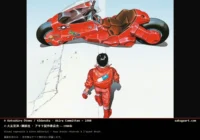
The direct influence ofAkira on The Matrix (Wachowski, 1999) is acknowledged by the Wachowskis themselves — cyberpunk, psychic energy, the opposition between a visible reality and a buried truth. More recently, Stranger Things, Chronicle, Looper, and Kanye West's music video for Stronger (2007) visually quote Kaneda's red motorcycle or Tetsuo's cellular transformation. Ready Player One by Spielberg (2018) puts Kaneda's motorcycle directly into its tribute to 1980s pop culture.
On the worldwide spread of anime
Akira is the work that opened the Western market to adult anime. Before 1989, Japanese animation in the West was either confined to children's series or invisible. In France, Akira was the trigger that allowed Glénat to publish the manga (from March 1990), and then the specialized publishers of the 1990s (Kana, Tonkam, Pika) to build a market. Without Akira, the path of manga and anime in the West would have been profoundly different.
Authentication — spotting copies
Akira is one of the most counterfeited works in Japanese animation. Several points call for vigilance.
— Fan cels and reproduction cels circulate widely online. A piece with no documented provenance, no original production envelope and no reference drawing (douga/genga) should be treated with skepticism.
— Authentic Akira cels generally carry production markings (sequence letter, shot number); a cel with no marking at all is suspect.
— Be especially wary of pieces labeled "Streamline Pictures 1988": the use of the American distributor's name can be a cover for reproductions.
— Original production envelopes in Japanese, sometimes annotated by hand, are a strong indication of authenticity — but they too can be counterfeited.
Further reading
Akira is a hub in the SAKUGAART collection, connecting several articles already published. Reading across the following threads offers a deeper look at technical or contextual aspects touched on here.
History of Tokyo Movie Shinsha · from Lupin III to Akira
Profile + Neo-Tokyo backgrounds · SAKUGAART profile available
All three took part in the subcontracting
The Japanese animation tradition Akira inherits
Studios that inherited its standard of finish
Tsutomu Ōhashi · the collective · the composition method
Sources & references
- Wikipedia EN — Akira (1988 film)
- Wikipédia FR — Akira (manga & film)
- ComicBook.com — Shigeru Watanabe · actual budget
- The Japan Times — Akira at 30
- The Japan Times — Staff & key animators
- Zentara — Top 10 Facts
- Anime News Network — Kimie Yamana · color
- IMDb — Akira: Production Report (1988)
- Heritage Auctions — The Art of Anime 2021
- Wikipedia EN — Symphonic Suite Akira
- Qobuz — Akira OST · DX7 · D-50
Methodological note. Quotations attributed to Katsuhiro Ōtomo are sourced from public documentation — Wikipedia (compiled interviews), the bonus material of the 1988 Japanese LaserDisc, and conversations reported by The Japan Times. Production figures come from Wikipedia EN, partly corrected by producer Shigeru Watanabe (Twitter, June 5, 2020). The Japanese box-office figure (about ¥750 million) is the one reported by The Japan Times; the ¥6.3 billion figure circulating online does not match the film's theatrical run in Japan. Article written for SAKUGAART.