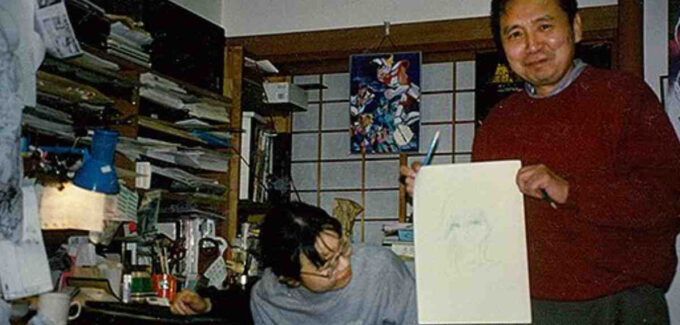



Spotted an error? Did you work on this production, or do you keep a memory or a document from it? We would be glad to hear from you.
Shingo Araki, the golden engraver of the Knights of the Zodiac
From the 25-year-old inbetweener hired by Mushi Production in 1964 to the character designer celebrated worldwide for Saint Seiya in 1986, Shingo Araki spent forty-five years in Japanese animation and left on it a graphic signature like no other: angular faces, intense gazes and hair split into dramatic locks for the male heroes; sophisticated elegance and delicacy for the female figures, developed together with his collaborator Michi Himeno, often described as his wife. From Kimba the White Lion to Grendizer, from The Rose of Versailles to Saint Seiya, by way of Captain Harlock, Lupin III, Ulysses 31 and Cat's Eye, his influence spans almost every animated series that shaped the imagination of a generation of viewers in France and across Europe.
Nagoya, Aichi Prefecture
Itabashi, Tokyo · aged 72
& animation director
Inbetweener on Jungle Taitei
then Araki Production · 1975
Toei Animation · 114 episodes
met in 1973 on Cutey Honey
Tokyo Movie Shinsha · Mushi
1964 - 2009
Before animation — Aichi, manga, advertising
Shingo Araki was born on January 1, 1939, in Nagoya, Aichi Prefecture, in a Japan still at war. He took to drawing early: from the age of five, he copied the illustrations he found in newspapers — the founding gesture of a vocation that nothing in his family background suggested. His entire training was that of an autodidact; he never attended a recognized art school.
In the mid-1950s, while working in railway-car manufacturing, he made his debut as a semi-professional cartoonist in Machi, an anthology of adult gekiga published by Central Shuppansha and distributed through rental bookshops (kashihon). Reference entries date this debut to 1955 and put his age at sixteen or eighteen, depending on the source. He went on to draw some sixty short stories for the rental circuit. The years 1955–1964 were a long journey through the margins of commercial drawing: illustrations for advertisements, covers for children's books, and early manga attempts on themes unexpected for the time — westerns, sports. These unusual subjects for a Japanese manga artist of the 1950s reveal a graphic curiosity turned toward Western models and their cinema. None of this work has survived in widely available form.
“Around the age of five, Shingo Araki began copying drawings he saw in newspapers, which was the starting point of his passion. Later, in his twenties, he began his professional career with illustrations for advertisements and children's books. He then moved into manga, with rather original creations whose themes were westerns or sports.”
Wikipédia · article Shingo Araki
fr.wikipedia.org/wiki/Shingo_Araki
The turning point came in 1964. At 25, Araki caught the attention of Mushi Production, the studio founded by Osamu Tezuka in 1961, which then dominated Japanese animation with its auteur film (Tales of a Street Corner, 1962) and with Japan's first animated TV series (Astro Boy, launched in 1963). For a self-taught artist from Nagoya, joining Mushi was the only serious way into animation at the time.
Mushi Production and Studio Jaguar
Araki joined Mushi Production in 1964 as an inbetweener — the junior role in the production chain that consists of drawing the missing frames between two key frames to ensure smooth movement. It is the classic apprenticeship position in Japanese animation, where the grammar of movement is learned through copying and repetition, sometimes for two or three years before moving on to key drawing.
His first confirmed credits are Jungle Taitei (Kimba the White Lion, 1965–1966), the first color series in Japanese animation, followed by Ribbon no Kishi (Princess Knight, 1967–1968) and Shin Jungle Taitei Susume Leo (1967), all three adapted from Osamu Tezuka's manga. Working alongside Tezuka was a school in itself: Araki absorbed the principles of limited animation developed by the studio to produce weekly animation on tight budgets — a technique that would define the standards of Japanese television for two decades.
In 1966, just two years after joining Mushi, Araki founded his own studio, Studio Jaguar, with a few colleagues. The move was early but in keeping with his temperament: he kept his position at Mushi while building his own subcontracting outfit — a common practice in the animation ecosystem of the 1960s, where the best animators held several roles at once. Studio Jaguar never had a real public identity: it operated as a technical collective subcontracting for the major clients.
In 1970, Araki took a crucial step: he made his debut as animation director on Ashita no Joe (Tomorrow's Joe), the emblematic gekiga series of the 1970s and the first true adult adaptation of a realistic sports manga. He directed the animation of some twenty episodes — episodes 4, 6, 9, 13, 16, 18, 21, 23, 26, 30, 34, 40, 47, 50, 56, 62, 66, 71 and 76, according to the credits compiled by Anime News Network. The hard, expressive gekiga style suited him perfectly: Joe Yabuki's angular face marked the arrival of muscular, realistic drawing in television anime.
Then came Mahō no Mako-chan (1970), Moonlight Mask (1972), Mahō Tsukai Chappy (1972), Kyojin no Hoshi (1971) — sports, magical girl, action. Araki swept through the entire television spectrum at high speed.
1972 marked a decisive breakthrough: Araki was credited on the anime adaptations of Gō Nagai's manga. Devilman (1972), Cutie Honey (1973), then UFO Robo Grendizer (1975) — Goldorak in France. It was on Babel II in 1972–1973 that he earned his first character designer credit, the role that would define the rest of his career. Character design has its own rules: creating the model sheet (settei) that serves as the reference for dozens of subcontracted animators to keep the drawing consistent throughout a series.
The Toei decade — meeting Himeno
Toei Animation, which then dominated the market for magical girl shōjo series, called on Araki from the early 1970s. His contribution to the fundamentals of the subgenre was considerable but often barely visible in the credits, because he worked as animation director rather than as lead character designer. On Cutie Honey (1973), he reworked the heroine's face — sleeker, more charismatic and more modern than in Nagai's manga — and gave the pilot episode the sleek, energetic tone that defined the rest of the series.
It was precisely on Cutie Honey that the decisive encounter of his career took place. Michi Himeno (姫野 美智, born August 16, 1956, in Hyōgo Prefecture), then seventeen, was a trainee at Toei working as an intermediate artist. Struck by Araki's designs for Babel II, she asked for the chance to work alongside him. The collaboration began as a simple hierarchical relationship — she was his assistant — but quickly evolved into a balanced creative partnership.
“Michi Himeno first met Shingo Araki during the production of Babel II in 1973, where she was impressed by his character designs and sought to collaborate with him through Toei Animation. Their professional partnership solidified in the mid-1970s, with Himeno taking the role of character designer and Araki that of animation director, culminating in the founding of Araki Production in 1975.”
Grokipedia · article Michi Himeno
grokipedia.com/page/michi_himeno
The division of tasks quickly became the duo's signature: Araki drew the angular, muscular male figures with square jaws and tense gazes; Himeno took charge of the female figures — softer, more elegant, with finer features. The contrast between their styles allowed them to cover a series' entire dramatic range through the visual complementarity of their characters. It is a rare equation in Japanese animation, where character design is usually entrusted to a single creator.
The two artists are often described as husband and wife; no accessible primary source documents the marriage, however, and some sources speak only of an artistic partnership. Their collaboration would become, in the phrase used by the specialized press, the Dynamic Duo.
Araki Production — the birth of the duo
In 1975, Araki and Himeno together founded Araki Production (sometimes spelled Araki Productions). The studio brought together several trusted colleagues from Toei and Mushi — notably Akio Sugino, Akihiro Kanayama and Nobuyoshi Sasakado. From then on, the duo offered its services to the major clients through this company: Toei for family and shōjo series, TMS Entertainment (Tokyo Movie Shinsha) for international co-productions and the Lupin III adaptations, and gradually the Western studios seeking to subcontract work in Japan.
The young company's first major commission was UFO Robo Grendizer (1975–1977), released in France under the title Goldorak and broadcast on Antenne 2 from July 3, 1978. Araki was character designer on the series, which left a deep mark on a generation of French viewers. His version of Duke Fleed (Daisuke Umon) — a face deliberately harder than Nagai's, more tragic, more deeply marked by exile — became the archetype of the animated hero in Europe for two decades.
The late 1970s saw the duo deliver one flagship title after another: Majokko Megu-chan (1974), Lupin III (Part II, 1977), Danguard Ace (1977), Farewell to Space Battleship Yamato: In the Name of Love (Saraba Uchū Senkan Yamato: Ai no Senshi-tachi, 1978) — the first time Araki served as animation director on an entire feature film — then Versailles no Bara (The Rose of Versailles, 1979), based on Riyoko Ikeda's manga.
The adaptation of The Rose of Versailles is emblematic of the duo's work: Araki is credited with character design and animation direction, but it was in fact Himeno who supervised the female figures with particular finesse, down to the lace of Marie Antoinette's gowns and Oscar's military uniforms. This series, created in 1979 at Tokyo Movie Shinsha, left a deep mark on Japanese female audiences and, later, on French viewers, who discovered it as Lady Oscar on Antenne 2 in 1986.
The Ulysses 31 turning point
In 1981 came a singular episode in Araki's career: the Franco-Japanese co-production Ulysses 31 between TMS (on the Japanese side) and DIC (Jean Chalopin's studio, on the French side). The initial character design was entrusted to the Frenchman René Borg, but it failed to convince the TMS producers, who found the figures too “European.” Araki was called in to rethink the secondary female characters — Thémis, Noumaïos, Circe, Penelope, Eurydice — to appeal to Japanese audiences.
“In 1981, Ulysses 31, the fruit of a collaboration between Araki Productions (for TMS) and DIC (a French studio), came into being. The characters were developed by director Bernard Deyriès (The Care Bears and The Mysterious Cities of Gold), with the exception of Thémis, Noumaïos and the secondary female characters (Circe, Penelope, Eurydice…), which were entirely entrusted to Shingo Araki and Michi Himeno.”
Le Grenier de la Télé · Shingo Araki et Michi Himeno
greniertv.over-blog.com/article-shingo-araki-et-michi-himeno
Ulysses 31 crystallizes a crucial economic feature of Araki Production: the company served as a buffer between the conflicting aesthetic needs of international co-productions and the sensibilities of Japanese audiences. This skill in graphic adaptation later opened collaborations for Araki on Inspector Gadget (1982–1986, a French-Canadian-Japanese co-production via DIC and TMS) and Mighty Orbots (1984, MGM/TMS).
Then came Baxinger (1982), Arcadia of My Youth: Endless Orbit SSX (1982), based on Leiji Matsumoto, Cat's Eye (1983), based on Tsukasa Hōjō, Aishite Knight (Kiss Me Licia, 1983), Lupin III Part III (1984), Glass Mask (1984), Tongari Bōshi no Memoru (1984), Maple Town (1986). By this point, Araki Production was one of the indispensable providers of character design for Japanese television animation for Toei and TMS.
Saint Seiya — worldwide consecration
In 1986, Toei Animation decided to adapt Saint Seiya , Masami Kurumada's manga serialized since 1985 in Weekly Shōnen Jump (Shūeisha). The project was entrusted to a heavyweight team: Kōzō Morishita directing, Takao Koyama on scripts, Seiji Yokoyama on music, Tadao Kubota as art director and Kunio Tsujita on color. The Araki–Himeno duo took on character design and animation direction.
The task was delicate. Kurumada's line in the manga, energetic as it was, lacked the graphic precision required for a high-budget TV adaptation running at least fifty-two weeks. Araki therefore had to carry out considerable adaptation work: reworking each character, drawing up precise model sheets (settei) and, above all, completely redesigning the armor. This last constraint stemmed both from animation requirements (the manga's armor was too complex to animate on a weekly series) and from a commercial demand by Bandai, which wanted designs it could sell as Myth Cloth figures.
“While the overall design remains relatively close to Masami Kurumada's in broad terms, there was notable adaptation work, particularly on the characters' appearance but also on the armor (owing to animation constraints, but also to Bandai's wish to sell figures, as the heroes' first armor in the manga did not seem satisfactory enough to be marketed without a drastic change), with the choice of colors handled by Kunio Tsujita.”
SaintSeiyaPedia · Shingo Araki article
saintseiyapedia.com/wiki/Shingo_Araki
The Saint Seiya TV series totals 114 episodes broadcast on TV Asahi between October 11, 1986, and April 1, 1989, accompanied by four feature films on which Araki is credited as character designer and animation director:
| Year | Title | Araki's credit |
|---|---|---|
| 1986-89 | Saint Seiya — TV series | Character Design · Animation Director (OP1–2 / ED1–2 credits) |
| 1987 | Saint Seiya: Evil Goddess Eris (film) | Character Design · Animation Director · Key Animation |
| 1988 | Saint Seiya: The Heated Battle of the Gods (film) | Character Design · Main Animation Design · Animation Director |
| 1988 | Saint Seiya: Legend of Crimson Youth (film) | Character Design · Main Animation Design · Animation Director |
| 1989 | Saint Seiya: Warriors of the Final Holy Battle (film) | Character Design |
| 2002-08 | Saint Seiya: The Hades Chapter (OVA — Sanctuary · Inferno · Elysion) | Character Design · Chief Animation Director |
| 2004 | Saint Seiya Heaven Chapter: Overture (film) | Character Design · Animation Director |
The series' international success was considerable. It was broadcast in France from April 6, 1988, on TF1 in the Club Dorothéeprogram, under the title Les Chevaliers du Zodiaque, in a French dub produced for broadcast on Club Dorothée — an adaptation with a free hand in its vocabulary, which helped anchor the work in French popular culture. The series was also broadcast widely in Italy, Spain and Latin America, and later in the United States in the 2000s.
For Araki, it was the crowning work. His line — the angular faces of the Bronze Saints, the golden lines of the armor, the intense gazes in scenes of suffering — became for millions of viewers the face of Japanese animation. Success brought a singular twist: many fans came to prefer the Araki–Himeno designs to Kurumada's original line, to the point that Kurumada's own later re-editions of the manga sometimes moved closer to the animation style.
Kurumada's manga created the Knights. Araki's line made them legendary.
A separation, a reconciliation
When the TV broadcast ended in 1989, the Araki–Himeno duo parted ways professionally: Himeno went freelance and worked on other projects of her own. But when Toei decided in 2002 to produce The Hades Chapter — the long-awaited OVA adaptation of the final part of the manga — the duo reunited. Araki returned as character designer and chief animation director, Himeno as animation director and associate character designer. The result was praised by critics for preserving the graphic consistency of the original series while incorporating the technical advances of 2000s digital animation.
The Araki style — a graphic signature
Araki's style is recognizable at first glance. Four elements characterize it and set it apart from the other great character designers of his generation — Yoshinori Kanada, Akio Sugino, Yoshikazu Yasuhiko.
1. The geometry of the male face
Araki's male heroes all share an angular, almost geometric facial structure: square jaw, high and pronounced cheekbones, cleft chin, straight nose. This construction gives the characters a sculptural presence that stood out from the round, soft designs dominating Japanese television in the 1970s. He did not hesitate to exaggerate the contrasts of light and shadow on faces, which made his drawings particularly suited to gekiga and to fight scenes.
2. The intense gaze
The eyes of Araki's heroes are distinctive: large, slightly elongated, topped by thick eyebrows, with a highly detailed iris. Several sources note that the eyes of the espers (Babel II) and the knights (Saint Seiya) are rendered with a precision rare in television animation. The width of the gaze and the relative position of the lashes create a strong emotional expressiveness, particularly suited to scenes of tragedy and combat.
3. Hair in dramatic locks
The hair of Araki's heroes is another marker: long, thick locks split into several dynamic blocks extending well beyond the head, often painted with strong lighting effects. This signature reached its peak in Saint Seiya, where each knight wears a distinctive haircut as recognizable as his armor: Seiya's split fringe, Shun's long hair, Hyōga's golden hair.
4. Sculptural depth
A technical feature rare in Japanese television: Araki made early use ofdepth shading techniques to give characters three-dimensional volume. According to IMDb, he was one of the first animators in Japan to introduce depth and perspective into character design through color and shading, giving the characters a more three-dimensional, solid look.
This dimension is particularly visible in the fight scenes of Saint Seiya, where the characters' muscles are shaded with almost anatomical precision — a method that required more cels and remained characteristic of Araki Production until the end of the 1990s.
Major filmography
This filmography does not claim to be exhaustive — Araki is credited on more than a hundred productions in total. It brings together the landmark works best known to Western audiences, as well as the titles that marked important transitions in his career.
TV series — key works
| Year | Original title | Western title | Role |
|---|---|---|---|
| 1965 | Jungle Taitei | Kimba the White Lion | Inbetweener |
| 1967 | Ribbon no Kishi | Princess Knight | Inbetweener |
| 1970 | Ashita no Joe | Tomorrow's Joe | Animation Director |
| 1972 | Devilman | Devilman | Animation |
| 1973 | Babel II | Babel II | Character Design |
| 1973 | Cutie Honey | Cutie Honey | Character Design Animation Director |
| 1974 | Majokko Megu-chan | Meg the Little Witch | Character Design |
| 1975 | UFO Robo Grendizer | Goldorak | Character Design Animation Director |
| 1977 | Lupin III (Part II) | Lupin the 3rd Part II | Character Design |
| 1979 | Versailles no Bara | The Rose of Versailles (Lady Oscar) | Character Design Animation Director |
| 1979 | Hana no Ko Lunlun | Lulu the Flower Angel | Animation · character design by Himeno |
| 1981 | Uchū Densetsu Ulysses 31 | Ulysses 31 | Character Design (female characters) |
| 1982 | Arcadia of My Youth: SSX | Endless Orbit SSX | Character Design Animation Director |
| 1982 | Inspector Gadget | Inspector Gadget | Key Animation (season 1) |
| 1983 | Cat's Eye | Cat's Eye | Animation Director |
| 1983 | Aishite Knight | Kiss Me Licia | Animation Director |
| 1984 | Lupin III Part III | — | Character Design |
| 1984 | Glass no Kamen | Glass Mask | Animation (opening credits) |
| 1984 | Mighty Orbots | Mighty Orbots | Animation |
| 1986 | Saint Seiya | Les Chevaliers du Zodiaque | Character Design Animation Director |
| 1991 | Yokoyama Mitsuteru Sangokushi | Romance of the Three Kingdoms | Character Design |
| 1993 | Aoki Densetsu Shoot! | — | Character Design |
| 1996 | Gegege no Kitarō (TV 4) | Kitaro | Character Design |
| 1997 | Kindaichi Case Files | The Kindaichi Case Files | Character Design |
| 1998 | Yu-Gi-Oh! | Yu-Gi-Oh! | Character Design |
| 2000 | Yu-Gi-Oh! Duel Monsters | Yu-Gi-Oh! | Character Design |
| 2004 | Ring ni Kakero 1 | — | Character Design |
Feature films — selection
| Year | Title | Credit |
|---|---|---|
| 1972 | Panda Kopanda (Panda! Go Panda!) — Hayao Miyazaki | Animation |
| 1977 | Ikkyū-san Chiekurabe | Animation Director |
| 1978 | Saraba Uchū Senkan Yamato — Farewell to Space Battleship Yamato | Animation Director (first feature film) |
| 1986 | Amon Saga (OVA) | Character Design · Animation Supervisor |
| 1990 | The Rose of Versailles: I'll Love You As Long As I Live | Animation Director |
| 1991 | Dragon Fist (OVA) | Character Design · Animation Director |
| 1996 | Gegege no Kitarō: Daikaijū | Character Design · Animation Director |
| 1999 | Yu-Gi-Oh! (film) | Animation Director |
| 2001 | The Siamese — First Mission | Character Design |
Legacy — the artbook and the heritage
Shingo Araki died on December 1, 2011, in Itabashi, Tokyo, at the age of 72. The exact cause of death was not publicly detailed. Anime News Network reported the news the very next day (“St. Seiya/Versailles/Yu-Gi-Oh! Designer Shingo Araki Passes Away,” December 1, 2011). The news prompted a wave of tributes, notably among French-speaking fans of Saint Seiya and Grendizer — in France and across the French-speaking world, his is one of the few names in Japanese animation recognized well beyond specialist circles.
The commemorative artbook
At the end of 2012, his son Shinji Araki published a 380-page posthumous artbook, limited to 1,000 copies worldwide, tracing his father's work through many previously unpublished drawings — preparatory sketches, original illustrations, unused model sheets. The book is now out of print.
The stylistic legacy
Araki's influence on later generations of character designers is documented and explicit. Tite Kubo, creator of the manga Bleach, has said in several interviews that he was influenced as a child by Saint Seiya and Araki's line — his own designs for the Shinigami, with their split hair and angular faces, clearly bear its trace. More broadly, the graphic standard of shōnen animation from the 1990s to the 2010s (Yu Yu Hakusho, Slam Dunk, Rurouni Kenshin, Hunter × Hunter) owes much to Araki's grid of proportions, and in particular to the principle of building the male face from triangles rather than circles.
Related articles on SAKUGAART
Araki's profile connects to several threads of our editorial corpus: the profiles of Mushi Production and Tezuka Productions, where he started out; that ofAkio Sugino, his co-founder at Araki Production; the articles devoted to Lupin III, Goldorak, The Rose of Versailles (Lady Oscar), Captain Harlock, Ulysses 31, Knights of the Zodiac, Cat's Eye — all works on which Araki is credited and which have detailed entries in the corpus. The profile of Michi Himeno, his artistic partner, often described as his wife, completes this diptych.
Sources & references
- Wikipédia FR — Shingo ArakiBiography · complete filmography
- Manga Fandom — Shingo ArakiBiography (EN) · cross-references
- IMDb — Shingo ArakiExhaustive credits · professional biography
- IMDb — Shingo Araki BiographyTechnical details (first to introduce depth)
- Anime News Network — Shingo ArakiEpisode-by-episode filmography
- SaintSeiyaPedia — Shingo ArakiSpecialized French-language source · Saint Seiya context
- Manga News — Shingo ArakiAuthor entry (in French)
- Le Grenier de la Télé — Shingo Araki et Michi HimenoAnalysis of the duo · French context
- Grokipedia — Shingo ArakiGraphic style · technical contributions
- Grokipedia — Michi HimenoAraki–Himeno meeting · division of tasks
- Alchetron — Shingo ArakiFilmography · biography
- PeoplePill — Shingo ArakiOVA and feature filmography
- Next Time Gadget Blog — Inspector Gadget tributeWork on Inspector Gadget · death
Methodological note. No direct interview with Shingo Araki in French or English was identified for this article. The only accessible interviews are in Japanese (notably in Animage and OUT between 1986 and 1990 for Saint Seiya), and have not been translated. The quotations used are sourced excerpts from public documentation (Wikipédia, specialized sites). The date of birth (January 1, 1939) follows the consensus of Wikipédia FR, SaintSeiyaPedia and Alchetron; Manga Fandom gives an alternative date of February 28, 1938, but it is a minority view among specialized French and English-language sources. Several Japanese reference entries date his arrival at Mushi Production to 1964, while English Wikipedia gives 1965; we use 1964. His marriage to Michi Himeno, put forward by several sources, is not supported by any accessible primary document.