


Spotted an error? Did you work on this production, or do you keep a memory or a document from it? We would be glad to hear from you.
Creator feature · 1928-1989 · Manga artist · Animation director · Doctor of medicine
Osamu
Tezuka
手塚 治虫 · てづか おさむ · 鉄腕アトム · ジャングル大帝 · 火の鳥 · ブラック・ジャック
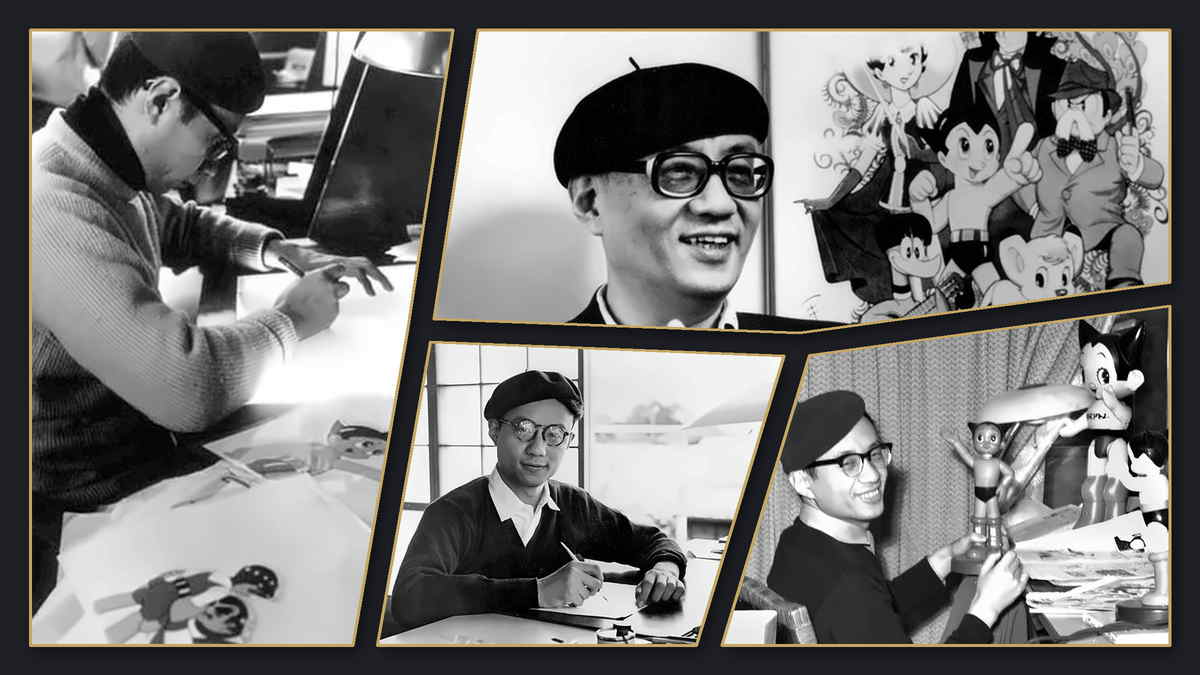
An Osaka medical student, insect collector and Disney reader laid the foundations of modern narrative manga and of the Japanese animated television series between 1946 and 1989. From Astro Boy to the surgeon Black Jack, from Kimba the White Lion to Phoenix, Osamu Tezuka drew more than one hundred and fifty thousand pages, founded two studios, went through bankruptcy, then signed his most ambitious works in the second half of his life. This feature traces his career, his studios, his auteur films, his reception in France and around the world, and the legacy Japan is preparing to celebrate for his centenary in 2028.
Takarazuka: the insect child (1928-1945)
Osamu Tezuka was born on 3 November 1928 in Toyonaka, Osaka Prefecture, the eldest of three siblings. His given name, Osamu (治), echoes the festival of Emperor Meiji, Meiji-setsu, which fell on that day. When he was five, the family moved to the village of Obama, Kawabe District, Hyōgo Prefecture, which became the city of Takarazuka in 1954; he lived there until he left for Tokyo. The official website describes an open household where people read manga and watched cartoons: his mother bought him manga as toys and read them aloud to him, and according to his memoirs the house held up to two hundred of them.
Takarazuka, home of the all-female revue of the same name, with its splendour and cross-dressed roles, left a lasting mark: Princess Knight would be its most direct fruit. But the passion that shaped his childhood was entomology. The young Tezuka hunted insects in the hills and added to his name the character 虫, "insect", giving the signature "Osamu" (治虫). Entering Kitano Prefectural Middle School in Osaka in April 1941, he joined the art and natural history clubs and drew manga, which earned him the hostility of the military instructor; his drawing teacher, Mr Okajima (岡島吉郎), often defended him. He founded a zoology club, made illustrated bulletins by hand and, in January 1943, the first volume of a colour atlas of beetles (原色甲蟲圖譜).
The war caught up with the teenager. In August 1944 he was sent to a physical training camp, from which a fungal infection of the arms got him sent home; in September, labour mobilisation assigned him to an asbestos factory on the banks of the Yodo. On 12 April 1945, at the Shōchiku-za in Osaka, he saw Momotarō: Sacred Sailors, the first Japanese animated feature, and came out, as he often recounted, determined to make animation one day. He left middle school on 28 March 1945. The official website sums up what the bombings taught him.
「戦争体験から生命の尊さを深く知り、医学の道を志して後年医学博士になるが結局彼自身が一番望んだ職業を選んだ。」
"The war made him feel deeply the value of life; he chose the path of medicine and later became a doctor of medicine, but in the end he chose the profession he desired most."
— Official biography, Tezuka Productions, tezukaosamu.net (SAKUGAART translation)
The Osaka medical student and New Treasure Island (1945-1952)
On 1 July 1945, Tezuka entered the medical school attached to Osaka Imperial University. Six months later, on 1 January 1946, the Osaka edition of the Shōkokumin Shinbun, later the Mainichi Shōgakusei Shinbun, published the first instalment of a four-panel strip, Mā-chan no nikkichō (マアチャンの日記帳), which ran until 31 March. The student then led three lives: medicine, drawing and amateur theatre, with the Gakuyū-za troupe, where he acted in Dostoevsky and Kingsley and performed as a pianist.
On 20 August 1946, at a meeting of a Kansai cartoonists' club, the artist Shichima Sakai (酒井七馬) proposed a book to him. In January 1947 Shin Takarajima (新寶島), "New Treasure Island", appeared, based on an original idea by Sakai. The volume, sold outside the press circuit on Osaka's cheap book market, the "akahon", reached four hundred thousand copies according to the official website. Its opening, a car speeding towards the reader in a sequence of cinematically framed panels, became a founding myth: many authors of the next generation, from Fujiko Fujio to Shōtarō Ishinomori, said they decided to become manga artists after reading it.
Next, with akahon publishers, came a series of long stories that established "story manga": Lost World, Metropolis, Kitarubeki sekai. In 1950, an unplanned visit to the publisher Gakudōsha led him to meet Ken'ichi Katō, editor of Manga Shōnen, who entrusted him with Jungle Taitei (ジャングル大帝), published from November 1950 to April 1954. On 24 March 1951 he graduated in medicine; on 16 July 1952 he passed the national medical examination. He never practised.
Tokyo, Tokiwa-sō and story manga (1952-1961)
With his examination passed, Tezuka moved to Tokyo in 1952, above a grocery in Yotsuya, then in 1953 into a modest building in the Shiinamachi district of Toshima: Tokiwa-sō (トキワ荘). He stayed only until October 1954, but the room he left went to the two Fujiko Fujio, and the boarding house, around Hiroo Terada, Shōtarō Ishinomori, Fujio Akatsuka and a few others, became the cradle of an entire generation. In March 1954 the Kansai income rankings placed him first among cartoonists, with 2.17 million yen; in 1961 the national ranking put him first, with more than nine million.
The three founding series
In Kōbunsha's monthly Shōnen, the little robot of Atom Taishi (1951) became the hero of Tetsuwan Atom (鉄腕アトム), published from 1952 to 1968. In Shōjo Club, from January 1953 to January 1956, Ribon no kishi (リボンの騎士), Princess Knight, tells of a princess born with both a boy's heart and a girl's heart, who must disguise herself as a man to rule: the work is considered one of the matrices of modern shōjo manga. In Manga Shōnen, Jungle Taitei follows the story of the white lion Leo until his death.
| Work | Serialisation | Publication | French title |
|---|---|---|---|
| ★Shin Takarajima 新寶島 | Jan. 1947 | Book (akahon), with Shichima Sakai | La Nouvelle Île au trésor |
| ★★Jungle Taitei ジャングル大帝 | 1950-1954 | Manga Shōnen | Le Roi Léo |
| ★★Tetsuwan Atom 鉄腕アトム | 1952-1968 | Shōnen (Kōbunsha) | Astro Boy / Astro le petit robot |
| ★Ribon no kishi リボンの騎士 | 1953-1956 | Shōjo Club · new version in Nakayoshi (1963) | Princesse Saphir |
| ★★Hi no tori 火の鳥 | 1954-1988 | Manga Shōnen, then COM (late 1966) and other magazines | Phénix, l'oiseau de feu |
| Dororo どろろ | 1967-1968 | Weekly Shōnen Sunday | Dororo |
| Kirihito sanka きりひと讃歌 | 1970-1971 | Big Comic | Kirihito |
| ★★Buddha ブッダ | 1972-1983 | Kibō no tomo, then Comic Tom | Bouddha |
| ★★Black Jack ブラック・ジャック | 1973-1983 | Weekly Shōnen Champion (Akita Shoten) | Black Jack |
| Mitsume ga tōru 三つ目がとおる | 1974-1978 | Weekly Shōnen Magazine | Le Prince aux trois yeux |
| MW | 1976-1978 | Big Comic | MW |
| Hidamari no ki 陽だまりの樹 | 1981-1986 | Big Comic | L'Arbre au soleil |
| ★★Adolf ni tsugu アドルフに告ぐ | 1983-1985 | Shūkan Bunshun | L'Histoire des 3 Adolf |
| Ludwig B, Gringo, Neo Faust | 1987-1989 | Three series cut short by his death | Gringo (2009) |
In 1958, Biiko-chan and Manga seibutsugaku earned him the third Shōgakukan Manga Award. The same year he became an adviser to Tōei Dōga, where he devised the story and structure of Saiyūki (Alakazam the Great, released 14 August 1960): his first work in professional animation. On 4 October 1959 he married Etsuko Okada at the Hankyū Hotel in Takarazuka. On 19 January 1961, Nara Prefectural Medical University awarded him a doctorate for an electron-microscope study of atypical sperm cells in a freshwater snail. In August his son Makoto, the future filmmaker, was born.
Mushi Production and the birth of TV anime
In June 1961 Tezuka created the animation department of his company, which took the name Mushi Production (虫プロダクション) in January 1962, moved on 10 April into a new studio in Nerima and became a joint-stock company in December. On 5 November 1962, at the Yamaha Hall in Ginza, the studio's first public screening showed three films: the auteur short Aru machikado no monogatari (ある街角の物語) (Tales of a Street Corner), an experiment titled Osu, and the first episode of a series that no one yet knew would transform the industry.
On 1 January 1963 Fuji TV broadcast Tetsuwan Atom, the first Japanese animated series in a weekly thirty-minute format. Up to 31 December 1966, 193 episodes were produced; according to Tezuka Productions, ratings peaked at 40.3% and averaged 25%. Tezuka directed several episodes himself, drew storyboards for some and wrote others. To keep up a weekly pace with a small team, the studio pushed limited animation to the extreme: systematic reuse of drawings, a bank of cels, still shots animated by the camera.
The myth of the 550,000 yen
Tezuka claimed to have sold the episodes at a price far below their cost, around 550,000 yen, to win the market. This figure fed a lasting indictment: by selling animation on the cheap, he supposedly installed the low wages and punishing schedules of anime. Hayao Miyazaki put it most harshly, just after his death.
「手塚治虫に『神の手』をみた時、ぼくは彼と決別した」
"The day I saw the 'hand of God' in Osamu Tezuka, I broke with him."
— Hayao Miyazaki, title of his interview in Comic Box, May 1989, reprinted in Shuppatsuten 1979-1996 (SAKUGAART translation)
Historians today strongly qualify this account. Nobuyuki Tsugata, in Anime sakka to shite no Tezuka Osamu (2007), showed that the price actually paid was higher than the one Tezuka announced; Yūsuke Nakagawa, in Anime taikoku kenkokuki 1963-1973, argues that Mushi Pro paid its employees relatively well. For Tsugata, blaming Tezuka alone for half a century of anime budgets is an oversimplification.
Mushi Production series
| Series | Broadcast (Japan) | Channel | Distinctive feature |
|---|---|---|---|
| ★★Tetsuwan Atom | 1963-1966 | Fuji TV | 193 episodes · first 30-minute series Official |
| Shin Takarajima | 3 Jan. 1965 | Fuji TV | First one-hour animated TV special |
| W3 | 1965-1966 | Fuji TV | Science fiction |
| ★★Jungle Taitei | 1965-1966 | Fuji TV | First Japanese colour series · 52 episodes |
| Jungle Taitei, Susume Leo! | 1966-1967 | Fuji TV | Sequel, adult Leo |
| ★Ribon no kishi | 1967-1968 | Fuji TV | First episode co-directed with Sadao Tsukioka |
| Dororo | 1969 | Fuji TV | Historical fantasy |
| Fushigi na Melmo | 1971-1972 | Asahi Hōsō | Produced by Tezuka Productions |
| Wansa-kun | 1973 | Kansai TV | Mushi Pro's last series before the bankruptcy |
The studio was also a school. Rintarō, Gisaburō Sugii, Eiichi Yamamoto and Osamu Dezaki learned their craft there, and the generation it trained would run the studios of the following decades. On 30 April 1964 his daughter Rumiko was born; in 1965 Stanley Kubrick wrote to him offering work on the art direction of 2001: A Space Odyssey, an offer Tezuka declined. In 1968 he founded Tezuka Productions, a company devoted to his manga.
The filmmaker: Animerama and auteur films
Alongside industrial production, Tezuka never stopped making films for himself. Aru machikado no monogatari received the first Ōfuji Award of the Mainichi competition in 1963, Japan's main animation prize. Then came Memory and Ningyo (Mermaid, 1964), Shizuku (Drop, 1965), then Tenrankai no e (展覧会の絵), set to Mussorgsky's Pictures at an Exhibition (1966), which won another Ōfuji Award in 1967 and a prize at the Asian Film Festival. The feature film Jungle Taitei (1966) received the Silver Lion of Saint Mark in Venice in 1967.
Then came Animerama, a trilogy of adult features produced by Mushi Pro and distributed by Nippon Herald: Senya ichiya monogatari (千夜一夜物語), A Thousand and One Nights, released on 14 June 1969 and a great success; Cleopatra, co-directed with Eiichi Yamamoto, followed on 15 September 1970. The third part, Kanashimi no Belladonna (Belladonna of Sadness, 1973), was directed by Yamamoto, Tezuka having left the studio's presidency in June 1971.
The 1980s brought international recognition for these short films, made at Tezuka Productions with his own money. Jumping, a subjective-camera long take of a leap that never stops, won the Grand Prix and the UNESCO Prize in Zagreb on 15 June 1984. Onboro Film (Broken Down Film), a pastiche of a scratched and damaged silent western, won the Grand Prix of the first Hiroshima International Animation Festival on 23 August 1985. Mori no densetsu (森の伝説) (Legend of the Forest), completed in December 1987, retraces the history of animation from Disney to the industrial era to a Tchaikovsky symphony, and earned him his fourth Ōfuji Award in 1988.
| Film | Year | Format | Awards |
|---|---|---|---|
| ★Aru machikado no monogatari | 1962 | Short | 1st Ōfuji Award · Blue Ribbon Award · Arts Festival encouragement prize |
| Tenrankai no e | 1966 | Short | Ōfuji Award 1967 · Asian Film Festival 1967 |
| Jungle Taitei (film) | 1966 | Feature | Silver Lion of Saint Mark, Venice 1967 |
| Senya ichiya monogatari | 1969 | Feature · Animerama | Major box-office success |
| Cleopatra | 1970 | Feature · Animerama | Co-directed with Eiichi Yamamoto |
| Yasashii Lion | 1970 | Medium-length film (production) | Ōfuji Award |
| Hi no tori 2772 | 1980 | Feature | Inkpot Award, San Diego 1980 |
| ★★Jumping | 1984 | Short | Grand Prix and UNESCO Prize, Zagreb 1984 Official |
| ★★Onboro Film | 1985 | Short | Grand Prix, Hiroshima 1985 · Varna 1985 |
| Push, Muramasa | 1987 | Shorts | Shown at Hiroshima 1987 |
| ★Mori no densetsu | 1987 | Short | Ōfuji Award 1988 · CIFEJ Prize, Zagreb 1988 · Bourg-en-Bresse 1988 |
Bankruptcy and rebirth: Black Jack, Buddha, Phoenix
The early 1970s were the low point of his career. Critics judged him overtaken by gekiga, the realistic and violent manga carried by a new generation; Mushi Production fell into debt. The group's trading company, Mushi Pro Shōji, went bankrupt on 22 August 1973, and Mushi Production on 1 November. Tezuka had no longer been its president since June 1971, but he bore its debts and its disgrace.
Rebirth came from a boys' weekly. From November 1973, Akita Shoten's Weekly Shōnen Champion published Black Jack (ブラック・ジャック), initially planned for a few episodes as a tribute to his fiftieth anniversary: an unlicensed surgical genius, covered in scars, who operates for exorbitant fees. Each episode is a complete story, a lesson in medicine and a moral dilemma. Its success was immediate and lasting. In 1975 the series received the Japan Cartoonists Association Special Award, and Buddha, begun in 1972, the Bungeishunjū Manga Award. In 1977 Black Jack and Mitsume ga tōru received the very first Kōdansha Manga Award.
These years also saw dark, adult works: Kirihito, about a disease that turns people into beasts; Ayako, a post-war family saga; MW, about a chemical weapon and an amoral killer. Phoenix, a cycle of stories spread from the distant past to the ultimate future, became his summa. It was adapted for the cinema in live action by Kon Ichikawa in 1978, then in animation under his own general direction as Hi no tori 2772 (Phoenix 2772, 1980). In 1978 he also conceived for Nippon Television the first two-hour animated TV film in Japan, Bander Book, which launched an annual series of TV films. On 15 June 1977 Kōdansha began publishing his complete works in three hundred volumes, completed on 3 October 1984 and later extended to four hundred volumes.
The last ten years (1980-1989)
The 1980s were the years of an author at the height of his ambition. Hidamari no ki (A Tree in the Sun), a chronicle of the end of the shogunate through his own great-grandfather, a doctor, received the Shōgakukan Award in the adult category in 1984. Adolf ni tsugu (Message to Adolf), published from 1983 to 1985 in the news weekly Shūkan Bunshun, intertwines the destinies of three Adolfs, Hitler among them, around a secret about his origins; it received the Kōdansha Manga Award in 1986. Tezuka also returned to television with a new colour Tetsuwan Atom series, broadcast on Nippon Television from 1 October 1980 to 23 December 1981.
He became an ambassador. In March 1980 the Japan Foundation sent him to the United States as a "manga ambassador"; he spoke at the United Nations headquarters. He travelled to China, Brazil and Canada. In 1978 he became the first president of the Japan Animation Association, and in 1987 he chaired the international jury at Hiroshima, a festival whose creation he had supported. He received the Asahi Prize on 29 January 1988 for his body of work.
On 15 March 1988, abdominal pain took him to Hanzōmon Hospital in Tokyo; he was operated on on the 17th and discharged on 12 May. He still travelled, in November, to Shanghai, where he chaired the jury of the first international animation festival, his last commitment abroad. Readmitted on 3 October and operated on again on 5 December, he worked from his room on three series, Ludwig B, Gringo and Neo Faust. He died of stomach cancer on 9 February 1989, aged sixty, a month after the start of the Heisei era. His last words have become famous.
「仕事をさせてくれ」
"Let me work."
— Osamu Tezuka, his last words according to the Kōbe Shinbun, 5 February 2019 (SAKUGAART translation)
France and the French-speaking world: from Le Roi Léo to Angoulême
Tezuka was the first Japanese author to enter French homes. According to the official chronology, the Astro Boy series was exported from the 1960s to several countries, including France; but the first documented broadcast is that of Le Roi Léo (Kimba) on ORTF in 1972, often presented as the first Japanese cartoon on French television. The Belgian broadcaster RTBF sees it as Japan's first breakthrough into the European audiovisual landscape. According to a broadcast listing, it was the second series, Susume Leo!, from 20 December 1972; the original 1965 series did not arrive until 1990, under the title Le Retour du Roi Léo. Princesse Saphir (Princess Knight) followed on TF1 in December 1974, first titled Prince Saphir.
The 1980s generation discovered Astro, le petit robot, the 1980 colour series, on TF1: the Bibliothèque nationale de France holds the presentation brochure the channel published in 1985. Yoshio Takeuchi's feature Jungle Emperor Leo (1997), based on a story conceived by Tezuka, was released in French cinemas as Léo, roi de la jungle on 20 April 2005.
Tezuka in France, during his lifetime
Few readers know it: Tezuka knew France well. From 27 January to 1 February 1982 he was a guest of the tenth Angoulême comics festival, where he became friends with Mœbius; the following July he accompanied the French author to Kyōto and Nara during his visit to Japan. In June 1983 the Annecy festival invited him with A Thousand and One Nights and Cleopatra; he returned in 1987. In July 1985, at the Royal Saltworks of Arc-et-Senans, during a Franco-Japanese cultural summit, he gave a lecture on manga as a common language; in March 1987 the Japanese Ministry of Foreign Affairs sent him to speak in Nancy. From April 1984, the magazine Furansu, published in Tokyo by Hakusuisha for Japanese students of French, ran Black Jack in French translation. In 1988 Mori no densetsu was awarded by the youth jury of the Bourg-en-Bresse festival.
French editions
Tezuka's manga reached French bookshops late, with the publishing wave of the 1990s. Glénat published Black Jack from 1996 to 2000; Tonkam launched Bouddha in 1997, translated by Sylviane Guyader, then L'Histoire des 3 Adolf in 1998. Asuka, Kana (Sensei collection, with Astro Boy), Soleil (Princesse Saphir) and Isan Manga (Black Jack, deluxe edition, 2023-2026) followed. Since 2019 Delcourt/Tonkam has been reissuing his major titles in prestige format: Kirihito and Phénix in September 2019, Princesse Saphir in November 2025, with its sequel Les Enfants de Saphir in 2026.
| Work | France | Milestone |
|---|---|---|
| Le Roi Léo (Susume Leo!) | 20 Dec. 1972 · ORTF | First documented anime in France weak source |
| Princesse Saphir | Dec. 1974 · TF1 | First titled Prince Saphir weak source |
| Astro, le petit robot (1980) | mid-1980s · TF1 | 1985 TF1 brochure at the BnF |
| Le Retour du Roi Léo (1965) | 17 Sept. 1990 | Original series weak source |
| Black Jack (manga) | 1996 · Glénat | First French edition in volumes |
| Bouddha (manga) | 1997 · Tonkam | Translated by Sylviane Guyader |
| Léo, roi de la jungle (film) | 20 Apr. 2005 | Cinema release |
| Pluto (Urasawa, after Tezuka) | Jan. 2011 · Angoulême | Intergenerational Prize |
| Osamu Tezuka, Manga no kamisama exhibition | 25 Jan.-11 March 2018 · Angoulême | First major exhibition in Europe Official |
In January 2018, for the ninetieth anniversary of his birth and as part of "Japonismes 2018", the 45th Angoulême festival devoted the exhibition Osamu Tezuka, Manga no kamisama to him at the Angoulême museum, from 25 January to 11 March, presented as the first major retrospective of his work in Europe, with many original pages. The same month Pika published the graphic biography by Toshio Ban, his former assistant, Osamu Tezuka, une vie en manga (930 pages). In 2011 Pluto, Naoki Urasawa's reinterpretation of an Astro Boy story, had received the Intergenerational Prize at Angoulême.
Europe and the world: Astro Boy, Kimba and the Disney controversy
Internationalisation was built into Mushi Pro's project. In March 1963 Tezuka went to New York to negotiate with NBC; a screening took place on 10 March, a 52-episode contract was signed in May, and the series was broadcast in the United States from 7 September 1963 under the title Astro Boy. According to Tezuka Productions, it was then sold to the United Kingdom, France, West Germany, Australia, Taiwan, Hong Kong, Thailand and the Philippines. Jungle Taitei, designed from the outset for export in colour, became Kimba the White Lion in the United States. In China, Central Television broadcast Astro Boy from 17 December 1980, and Jungle Taitei in 1982; Tezuka took part in the launch campaign.
Kimba and The Lion King
In 1994, the release of Disney's The Lion King revived memories of Kimba: a royal lion cub, a wise baboon, a one-eyed villain, the father appearing in the clouds. The manga artist Machiko Satonaka sent Disney's Japanese distributor an open letter asking for a few lines acknowledging the origin of the story. Disney cited Hamlet and Bambi and denied any influence. Takayuki Matsutani, president of Tezuka Productions, stated that the two works were "absolutely different" and that Tezuka, had Disney been inspired by him, would have been flattered. No legal action was taken. Frederik Schodt, Tezuka's translator and friend, judged some scenes too close to be coincidence.
In the United States the admiration is also institutional: the Buddha series, published by Vertical, received the Eisner Awards for Best U.S. Edition of International Material in 2004 and 2005, and Tezuka was inducted into the Eisner Hall of Fame. In San Diego he received an Inkpot Award as early as 1980 for Hi no tori 2772. In 2003 a new Astro Boy series marked the robot's fictional birth date, 7 April 2003; the same year Naoki Urasawa began Pluto, which Netflix would adapt in 2023. In 2009 a Hollywood CGI feature, Astro Boy, was produced by Imagi.
Legacy: towards the 2028 centenary
The nickname "god of manga" (マンガの神様), given to him in his lifetime, poorly sums up a more diffuse influence. Fujiko Fujio, Shōtarō Ishinomori, Fujio Akatsuka, Mitsuteru Yokoyama, Hideko Mizuno, Masako Yashiro and Moto Hagio are among the authors who learned their craft in contact with him or by reading him. In 1971 he became head of the jury of the Tezuka Award, created by Shūeisha's Weekly Shōnen Jump to discover young authors. His grammar, cinematic framing, dynamic panel layouts, long narratives and characters recurring from one work to another (his "star system"), became the grammar of manga as a whole.
On 25 April 1994 the city of Takarazuka opened the Osamu Tezuka Manga Museum, around the theme of love of nature and respect for life; Tezuka Productions explains that Takarazuka was the obvious choice, so much had the city meant to him. In front of the entrance, the Phoenix statue became a symbol of reconstruction after the 1995 Kōbe earthquake. In 1997 the Asahi Shimbun created the Osamu Tezuka Cultural Prize, whose statuette represents Astro Boy; in 2025 it honoured the graphic autobiography of Rintarō, a Mushi Pro alumnus. 9 February, the day of his death, has been proclaimed "Manga Day" by the Mandarake bookshop.
A body of work still alive
In 2025 Tezuka Productions celebrated sixty years of the Jungle Taitei series, and in 2026 fifty years of Unico. Since 1 November 2025 the first Tetsuwan Atom series has been rebroadcast in full, over four years, by TV Saitama and made available online for the first time on TVer. On 8 August 2026 Netflix released worldwide The Ribbon Hero, a 108-minute feature loosely based on Princess Knight, directed by Yūki Igarashi at studio Outline and presented at the 2026 Annecy festival. In June 2026 an anthology published in book form for the first time the original version of Ari to kyojin, a 1961 story whose every page Tezuka had redrawn twice.
On 25 April 2026 the city of Takarazuka set up the council in charge of celebrating the centenary of his birth, on 3 November 2028, in partnership with Tezuka Productions. For French readers the moment is favourable: most of the work is now available in careful editions, and the most singular part of his output, his auteur films, remains to be rediscovered.
Chronology
| Date | Event | |
|---|---|---|
| 3 Nov. 1928 | Born in Toyonaka (Osaka) | Japan |
| 1 July 1945 | Enters the Osaka University medical school | Japan |
| 1 Jan. 1946 | ★Debut with Mā-chan no nikkichō | Japan |
| Jan. 1947 | ★Shin Takarajima, with Shichima Sakai | Japan |
| Nov. 1950 | Jungle Taitei begins in Manga Shōnen | Japan |
| 1952 | ★★Tetsuwan Atom begins; national medical examination (16 July); moves to Tokyo | Japan |
| 1953 | Moves into Tokiwa-sō; Ribon no kishi begins | Japan |
| 4 Oct. 1959 | Marries Etsuko Okada | Japan |
| 19 Jan. 1961 | Doctorate in medicine (Nara) | Japan |
| June 1961 | Creation of the future Mushi Production | Japan |
| 1 Jan. 1963 | ★★Tetsuwan Atom broadcast on Fuji TV | Japan |
| 7 Sept. 1963 | Astro Boy on NBC | United States |
| 6 Oct. 1965 | Jungle Taitei, first Japanese colour series | Japan |
| 1967 | Silver Lion of Saint Mark in Venice; Hi no tori in COM | Italy |
| 23 Jan. 1968 | Creation of Tezuka Productions | Japan |
| 14 June 1969 | Senya ichiya monogatari (Animerama) | Japan |
| 20 Dec. 1972 | Le Roi Léo on ORTF | France |
| 1 Nov. 1973 | Mushi Production goes bankrupt | Japan |
| Nov. 1973 | ★★Black Jack begins | Japan |
| 22 July 1977 | First Kōdansha Manga Award | Japan |
| Jan. 1982 | Guest at Angoulême, meets Mœbius | France |
| 1983 | Adolf ni tsugu begins; guest at the Annecy festival | Japan · France |
| 15 June 1984 | Jumping, Grand Prix in Zagreb | Yugoslavia |
| 23 Aug. 1985 | Onboro Film, Grand Prix in Hiroshima | Japan |
| 29 Jan. 1988 | Asahi Prize | Japan |
| 9 Feb. 1989 | ★★Dies aged 60 | Japan |
| 25 Apr. 1994 | Opening of the Osamu Tezuka Manga Museum in Takarazuka | Japan |
| 1997 | Creation of the Osamu Tezuka Cultural Prize | Japan |
| 25 Jan. 2018 | Manga no kamisama exhibition in Angoulême | France |
| 8 Aug. 2026 | The Ribbon Hero on Netflix | World |
| 3 Nov. 2028 | Centenary of his birth | Upcoming |